
"As an Amazon Associate, I earn from qualifying purchases. This helps support this site at no extra cost to you."
Boiled chicken is ready to shred when the thickest part has reached at least 165°F (74°C) and the cooked muscle fibers pull apart without raw, rubbery resistance. Temperature is the primary doneness check; easy fiber separation tells you whether the texture is suitable for shredding.
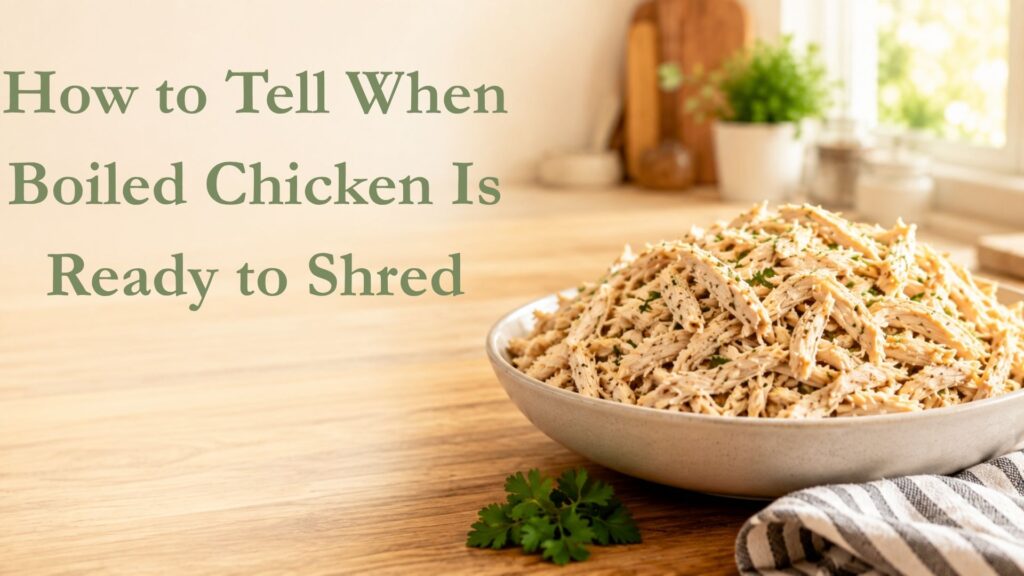
Properly cooked chicken should feel firm but yielding rather than hard. When you press a fork into an edge and pull, distinct strands should separate along the natural muscle-fiber direction instead of stretching or resisting.
These checks are part of boiling chicken specifically for shredding, where the goal is not simply cooked meat but a predictable balance between doneness, moisture, and easy fiber separation.
The Four Main Signs Chicken Is Ready to Shred
| Check | Ready to shred | Not ready |
|---|---|---|
| Internal temperature | At least 165°F (74°C) | Below the target |
| Fork resistance | Fork enters easily | Center feels rubbery or resistant |
| Fiber separation | Strands pull apart cleanly | Meat stretches or resists |
| Surface texture | Moist and firm | Raw-looking center or excessively dry edges |
Start With Internal Temperature
Use an instant-read thermometer in the thickest part of the largest piece. A reading of at least 165°F (74°C) establishes that the chicken has reached the minimum cooking target.
Do not rely only on how easily the meat pulls apart. A thinner outer section can feel tender while a thick center is still below temperature. Understanding the correct internal temperature for boiled chicken gives you a more reliable starting point than appearance alone.
Why Fiber Separation Changes During Cooking
Chicken muscle is arranged in long bundles of protein fibers. As those proteins heat, they tighten and change structure. At the same time, connective tissue surrounding and linking the bundles weakens enough for the cooked meat to separate along its natural grain.
Before enough heat reaches the center, those structures still resist pulling. After sufficient cooking, a fork can split the meat into recognizable strands with relatively little effort.
If cooking continues far beyond that useful point, the muscle proteins keep tightening and expelling moisture. The chicken may still shred easily, but the strands can become dry, stringy, or chalky.
How to Test Chicken Before Removing It
- Reduce the pot to a gentle simmer so the chicken is easier to handle.
- Choose the thickest or largest piece in the pot.
- Insert an instant-read thermometer into the thick center without touching bone.
- If the reading is at least 165°F (74°C), pull gently at one edge with two forks.
- Look for clean separation into cooked strands rather than rubbery resistance.
- Remove the chicken and let it rest for about 5 minutes before shredding the full batch.
The temperature and fork checks together normally take less than 1 minute.
What Properly Cooked Chicken Feels Like
When squeezed lightly with tongs, properly cooked chicken should feel firm enough to hold its shape but not hard or springy. Fork pressure should begin separating the fibers rather than merely denting the surface.
Breast meat generally produces cleaner, leaner strands. Thigh meat often feels softer because its higher fat and connective-tissue content creates a more yielding texture.
What If the Chicken Reaches 165°F but Feels Firm?
First check whether the firmness is simply the natural texture of the cut. Chicken breast is firmer than thigh meat and does not need to fall apart before it is ready to shred.
If the chicken has reached temperature and the fibers separate under fork pressure, remove it. Waiting until breast meat collapses on its own can push it beyond the most useful moisture window.
What Undercooked Chicken Feels Like When You Pull It
Chicken that is not ready often feels elastic or rubbery in the center. Instead of separating into individual bundles, the meat can stretch, resist the forks, or remain unusually smooth and dense.
If the thermometer remains below the target, return the chicken to the simmer and check again after another 2 to 3 minutes.
Signs the Chicken Has Cooked Too Long
- Dry edges: the outer fibers appear chalky or rough.
- Very fine stringiness: the chicken breaks into thin dry strands instead of moist shreds.
- Heavy moisture loss: the meat feels noticeably drier despite sitting in liquid.
- Crumbly breast meat: the fibers break instead of pulling into substantial strands.
Those signs can appear when chicken has been overboiled for shredding, especially with lean breast meat.
Should the Chicken Fall Apart in the Pot?
No. Falling apart without any pressure is not necessary for good shredded chicken. For most uses, the better endpoint is meat that holds together when lifted but separates readily once forks, fingers, or another shredding tool apply force.
This gives you better control over final strand size. Chicken that has become extremely soft may turn into fragments when mixed or shredded mechanically.
Best Shredding Time After Doneness
Let the chicken rest for about 5 minutes after removing it from the pot. It should be warm but no longer releasing heavy steam.
Warm chicken usually requires less shredding force because the fibers have not fully firmed during cooling. The rest also allows carryover heat to settle and some moisture to redistribute through the meat.
Tool Choice After the Chicken Is Ready
| Tool | Typical time | Texture | Effort | Main drawback |
|---|---|---|---|---|
| Two forks | 2 to 5 minutes | Medium, controlled | Medium | Slower for bulk prep |
| Hands | 1 to 4 minutes | Coarse to medium | Medium | Chicken must cool enough to handle |
| Hand mixer | 30 to 60 seconds | Fine | Low | Can over-shred quickly |
| Stand mixer | 20 to 60 seconds | Fine to medium | Low | Extra cleanup |
| Shredder bowl | 30 to 90 seconds | Short, fairly uniform | Low | Another tool to wash |
Best Texture for Different Uses
- Tacos: medium strands that hold sauce without disappearing into the filling.
- Soup: medium to coarse shreds that remain identifiable in broth.
- Chicken salad: medium, relatively dry-surfaced shreds that mix cleanly with dressing.
- Casseroles: fine to medium strands for even distribution.
- Meal prep: medium shreds provide the most flexibility for later dishes.
Best Readiness Test
Confirm at least 165°F (74°C) in the thickest part, then pull gently at an edge. If the fibers separate cleanly without raw resistance, remove the chicken, rest it for about 5 minutes, and shred while it is still warm.