
"As an Amazon Associate, I earn from qualifying purchases. This helps support this site at no extra cost to you."
Poaching is one of the most controlled ways to cook chicken for shredding because it uses gentle, moist heat rather than aggressive boiling. The goal is to cook the chicken completely while limiting unnecessary protein tightening and moisture loss, so the finished meat separates into clean, tender strands.
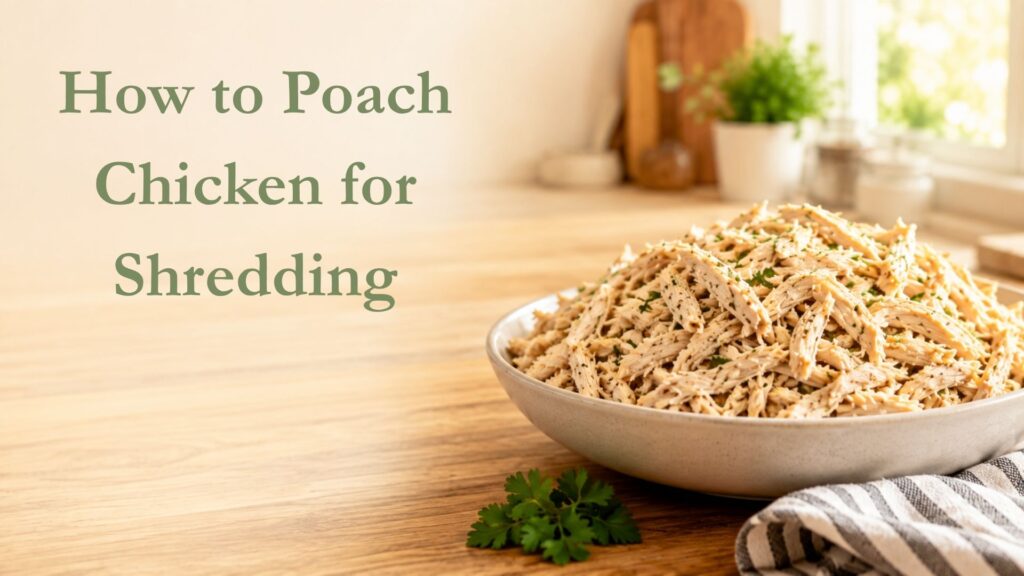
For most boneless chicken breasts, poaching takes roughly 12 to 18 minutes once the liquid is hot enough, although thickness matters more than the clock. The chicken should ultimately reach 165°F (74°C) in the thickest section before it is removed from the pot.
The method is especially useful for tacos, chicken salad, soup, casseroles, sandwiches, wraps, and meal prep because poached chicken has a relatively neutral flavor and can be shredded coarse, medium, or fine depending on the final dish.
How Poaching Makes Chicken Easier to Shred
Chicken breast is built from bundles of muscle fibers held together by connective structures. As heat enters the meat, muscle proteins tighten and connective tissue changes. Once the chicken is fully cooked, those fiber bundles can be pulled apart into strands.
The problem is that heat does two things at once. It makes the chicken safe and structurally ready to shred, but excessive heat also pushes moisture from the muscle fibers. The longer breast meat stays at high temperature, the firmer and drier those fibers can become.
Poaching gives you more control over this balance because the surrounding liquid stays calmer than boiling water. That slower heat transfer gives the center time to cook without subjecting the outside to unnecessary turbulence and aggressive heat.
Best Temperature for Poaching Chicken
True poaching uses liquid that is hot but below a vigorous boil. A useful working range is roughly 160°F to 180°F (71°C to 82°C). The surface may show an occasional small bubble, but it should not resemble a rolling boil.
Keeping the liquid controlled is central to the temperature range used for poaching chicken. If the liquid begins bubbling aggressively, reduce the burner and allow the pot to settle before continuing.
The poaching liquid temperature and the chicken’s final internal temperature are two separate measurements. The liquid may stay below boiling while the center of the chicken gradually reaches the required level of doneness.
How Long to Poach Chicken Breast for Shredding
Average boneless chicken breasts often need approximately 12 to 18 minutes in properly heated poaching liquid. Small breasts may finish sooner, while large or especially thick pieces can take 20 minutes or longer.
| Chicken breast | Approximate poaching time | Main variable |
|---|---|---|
| Small boneless breast | 10 to 15 minutes | Thickness |
| Average boneless breast | 12 to 18 minutes | Center temperature |
| Large or thick breast | 18 to 25 minutes | Thickness through the middle |
| Bone-in breast | 25 to 40 minutes or longer | Bone and total thickness |
The more detailed chicken-breast poaching time depends on thickness, starting temperature, pot size, and how steadily the liquid temperature is maintained.
Water or Broth for Poaching Chicken?
Both water and chicken broth work. Water gives the chicken the most neutral flavor and makes it easier to season for completely different dishes later. Broth gives the meat a more savory base from the start.
The choice between poaching chicken in water or chicken broth matters more for flavor than for shredding behavior. Muscle-fiber separation still depends primarily on heat, moisture, and doneness.
| Liquid | Flavor | Best use | Trade-off |
|---|---|---|---|
| Water | Very neutral | Meal prep for multiple dishes | Needs deliberate seasoning |
| Chicken broth | More savory | Soup, casseroles, sandwiches | May already contain substantial salt |
| Water with aromatics | Mild and adaptable | General-purpose shredding | Requires a few extra ingredients |
How Much Liquid Do You Need?
Use enough liquid to surround the chicken and cover it by roughly 1/2 to 1 inch. You do not need to fill a large stockpot for a few breasts.
The practical amount of liquid needed for poaching chicken depends heavily on the shape of the pot. A wide pan and a narrow saucepan can require very different volumes for the same chicken quantity.
An appropriately sized pot heats faster, needs less seasoning, and makes it easier to keep all pieces surrounded by liquid without stacking them tightly.
Should the Pot Be Covered?
A partially covered or fully covered pot reduces heat loss and evaporation. The trade-off is that trapped heat can make the liquid temperature climb faster than expected.
For most home stovetops, partially covering chicken while it poaches gives a useful balance. The lid retains heat while still allowing you to see whether the liquid is becoming too active.
Step-by-Step: How to Poach Chicken for Shredding
- Choose chicken pieces that are reasonably similar in thickness so they cook at a similar rate.
- Arrange the chicken in a saucepan or pot in a single layer where practical.
- Add enough water or broth to cover the chicken by roughly 1/2 to 1 inch.
- Add salt and mild aromatics if desired.
- Heat the liquid gradually over medium heat.
- As the liquid approaches a gentle poaching temperature, reduce the burner so the surface remains mostly calm.
- Partially cover the pot if you want to reduce heat loss while still monitoring the liquid.
- Begin checking average boneless chicken breasts after about 10 to 12 minutes.
- Insert a thermometer into the thickest central section of the largest piece.
- Remove each piece when it reaches 165°F (74°C).
- Let the chicken rest for approximately 5 minutes.
- Shred with forks, hands, a mixer, or a shredder bowl according to the texture needed.
How to Know When Poached Chicken Is Done
Use an instant-read thermometer in the thickest portion rather than relying on color or cooking time alone. The center should reach 165°F (74°C).
The most dependable way to determine when poached chicken is finished cooking is temperature. Fiber separation, firmness, and an opaque center can support that reading, but they should not replace it.
If several pieces differ significantly in size, check each large piece separately. Remove smaller breasts once they are done instead of keeping them in the pot while thicker pieces continue cooking.
How to Keep Poached Chicken Moist
Moisture control begins during cooking, not after shredding. Once chicken breast has been overcooked and its proteins have squeezed out substantial moisture, sitting it in liquid does not fully reverse the structural change.
- Keep the poaching liquid below a hard boil.
- Start checking temperature early rather than adding extra cooking time for reassurance.
- Remove smaller pieces as soon as they are done.
- Rest the chicken for about 5 minutes before shredding.
- Reserve some poaching liquid in case the finished shreds need light surface moisture.
These steps are the main controls for keeping poached chicken moist enough for shredding, especially when using lean breast meat.
Can You Poach Frozen Chicken?
Individual frozen chicken pieces can be cooked in liquid, but they require more time and give you less control over the difference between the exterior and center temperatures.
When poaching chicken directly from frozen, avoid compensating with a hard boil. The outside is already heating much faster than the frozen center, so excessive heat increases the chance of dry exterior fibers.
Several pieces frozen into one solid block are better thawed first because hot liquid cannot circulate between the pieces efficiently.
Best Seasonings for Poached Chicken
Poached chicken works well with restrained seasoning because the final shredded meat often receives another sauce, dressing, broth, or spice mixture later.
- Salt: basic seasoning, adjusted for whether broth is already salted.
- Black pepper: mild warmth without strongly defining the final dish.
- Garlic: savory depth for tacos, soup, casseroles, and meal prep.
- Onion: mild aromatic flavor.
- Bay leaf: subtle background flavor for neutral chicken.
- Thyme or parsley: mild herb character without overpowering the meat.
A simple combination of salt, garlic, onion, pepper, and a mild herb covers most uses. More specific seasonings for poaching chicken can be chosen according to whether the meat is heading toward tacos, soup, salads, or general meal prep.
Can You Shred Chicken Immediately After Poaching?
Yes, but chicken usually handles better after a short rest. Straight from the poaching liquid, the meat may be heavily steaming and difficult to work with safely.
Waiting about 5 minutes leaves the chicken warm enough for easy fiber separation while reducing surface heat. This is the useful middle ground when deciding whether to shred chicken immediately after poaching or allow it to cool longer.
Best Tools for Shredding Poached Chicken
| Tool | Approximate time | Texture | Mess level | Trade-off |
|---|---|---|---|---|
| Two forks | 2 to 4 minutes | Medium, irregular | Low | More hand effort |
| Hands | 1 to 3 minutes | Coarse to medium | Medium | Chicken must cool enough to handle |
| Hand mixer | 30 to 60 seconds | Fine | Medium | Easy to over-shred |
| Stand mixer | 20 to 60 seconds | Fine to medium | Low during mixing | More equipment cleanup |
| Shredder bowl | 30 to 90 seconds | Short, controlled | Low | Another tool to wash |
Poached Chicken Breast vs Boiled Chicken Breast
Both methods can produce shreddable chicken, but poaching uses less aggressive heat. Boiling creates stronger bubbling and faster surface heat transfer, which can tighten the outer muscle fibers sooner.
That makes the difference between poached chicken breast and boiled chicken breast primarily one of heat control. A gently simmered boiled breast can still shred well, but sustained rolling boiling gives you less margin before the meat becomes dry or stringy.
| Factor | Poaching | Boiling |
|---|---|---|
| Heat intensity | Gentle | Higher |
| Liquid movement | Minimal | Active |
| Moisture control | More forgiving | Less forgiving |
| Texture predictability | High | Moderate |
| Best fit | Controlled shredding | Fast basic cooking |
Best Shred Texture by Use Case
| Use | Best shred | Good tool | Why |
|---|---|---|---|
| Tacos | Medium to coarse | Forks or hands | Strands hold sauce while retaining texture |
| Chicken salad | Medium | Forks | Mixes with dressing without becoming pasty |
| Soup | Medium to coarse | Forks or hands | Remains recognizable in broth |
| Casseroles | Medium to fine | Forks or mixer | Distributes evenly |
| Meal prep | Medium | Forks, stand mixer, or shredder bowl | Versatile for multiple dishes |
How to Store Poached Chicken for Later Shredding
If the chicken will not be used immediately, cool and refrigerate it promptly in a shallow airtight container. Cooked chicken is generally best used within 3 to 4 days when properly refrigerated.
Leaving breasts whole or in large pieces reduces exposed surface area and can help with moisture retention. Shredding first provides more convenience but exposes many more fiber surfaces to air.
The choice depends on whether moisture retention or speed matters more. The practical options for storing poached chicken for later shredding include refrigerating it whole, in large pieces, or already shredded.
Common Poaching Mistakes
- Letting the liquid reach a rolling boil: excessive heat tightens the exterior fibers more aggressively.
- Using one fixed time for every breast: thickness can change cooking time substantially.
- Overcrowding the pot: liquid cannot circulate evenly around tightly stacked chicken.
- Using too little liquid: exposed sections may heat differently from submerged areas.
- Using far too much liquid: the pot takes longer to heat and seasonings become unnecessarily diluted.
- Leaving cooked chicken in hot liquid: carryover heat continues tightening the proteins.
- Waiting until chicken is fully cold before shredding: chilled fibers require more force to separate.
- Relying only on color: the thickest center should be checked with a thermometer.
If the Chicken Is Too Hot, Cold, Wet, or Dry
| Problem | What is happening | What to do |
|---|---|---|
| Too hot | Heavy steam and difficult handling | Rest about 5 minutes |
| Too cold | Fibers have firmed | Use forks or warm gently before shredding |
| Too wet | Surface liquid is pooling | Drain briefly before shredding |
| Too dry | Excess moisture was lost during cooking | Toss shreds with a small amount of warm poaching liquid |
| Over-shredded | Fibers have become too short and fine | Stop mechanical mixing sooner next time |
Best Overall Method
For reliable shredded chicken, place similarly sized pieces in an appropriately sized pot, cover them with water or broth, and heat the liquid gently rather than boiling aggressively. Maintain controlled poaching heat, begin checking before the expected cooking window ends, and remove each piece when its thickest section reaches 165°F (74°C).
Rest the chicken for about 5 minutes, then shred while it is warm. Use forks or hands for coarse to medium strands, or a mixer or shredder bowl when speed matters more than individual texture control. Keep some poaching liquid available so slightly dry shreds can be lightly moistened before serving or storage.