
"As an Amazon Associate, I earn from qualifying purchases. This helps support this site at no extra cost to you."
To boil chicken for shredding, place the chicken in a pot, cover it with water or broth by about 1 inch, bring the liquid toward a boil, then immediately reduce it to a gentle simmer. Cook until the thickest part reaches at least 165°F (74°C), rest the chicken for about 5 minutes, and shred it while still warm.
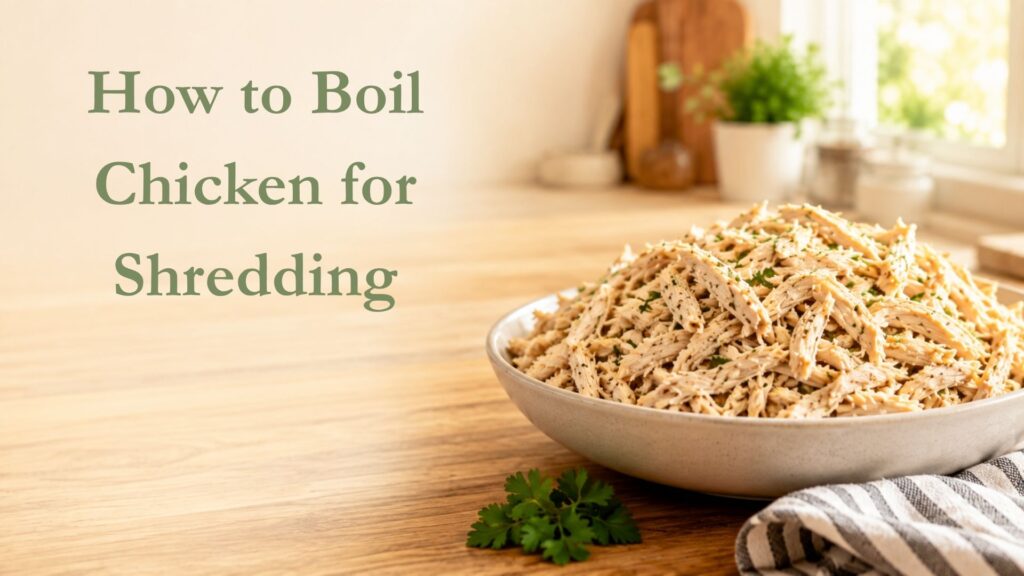
The most important part is heat control. Chicken does not need to remain at a violent rolling boil. Moderate simmering gives heat time to reach the center while reducing unnecessary moisture loss from the outer muscle fibers.
For most batches, expect boneless chicken breast to need roughly 12 to 15 minutes of gentle simmering, while thighs often take 15 to 20 minutes or longer depending on size and whether bone is present. Exact time is less important than internal temperature and texture.
Quick Method for Boiling Chicken to Shred
- Place the chicken in an appropriately sized pot.
- Add enough cool water or broth to cover the chicken by about 1 inch.
- Add light seasoning or aromatics if desired.
- Bring the liquid toward a boil over medium-high heat.
- Reduce the heat as soon as boiling begins and maintain a gentle simmer.
- Begin checking the chicken near the lower end of its expected cooking range.
- Remove each piece once the thickest part reaches at least 165°F (74°C).
- Rest the chicken for about 5 minutes.
- Shred while the meat is still warm but no longer heavily steaming.
For a normal household batch, the complete process usually takes about 25 to 40 minutes once heating, simmering, resting, and shredding are included.
Why Boiled Chicken Shreds Easily
Chicken muscle is built from long bundles of protein fibers held together by connective structures. Raw meat resists shredding because these bundles are still tightly organized.
During cooking, heat changes the shape of muscle proteins and causes them to tighten. At the same time, connective tissue softens enough for the cooked fiber bundles to separate along their natural grain.
That creates the shredding window: the chicken is fully cooked, the fibers pull apart with relatively little force, and enough moisture remains inside the strands to keep them tender.
If cooking continues much longer, the same protein tightening that made the meat firm continues pushing moisture out. Chicken may become even easier to pull apart while simultaneously becoming drier.
Chicken Breast or Chicken Thighs?
Both work well, but they produce different results. Breast meat gives leaner, cleaner, more distinct strands. Thigh meat produces softer, richer shreds and usually tolerates longer cooking without becoming dry as quickly.
| Factor | Chicken breast | Chicken thighs |
|---|---|---|
| Typical simmering time | About 12 to 15 minutes boneless | About 15 to 20 minutes boneless |
| Texture | Lean, distinct strands | Soft, richer strands |
| Fat content | Lower | Higher |
| Dryness risk | Higher | Lower |
| Best use | Salad, soup, wraps, light meal prep | Tacos, casseroles, sauced dishes, reheating |
When white-meat texture is the priority, knowing how long chicken breast needs to simmer before shredding helps prevent the narrow moisture window from turning into dry strands.
Dark meat is more forgiving, but thickness and bone still matter, so chicken thigh boiling time should be adjusted rather than copied directly from breast timing.
For mixed meal-prep batches, the differences between boiling chicken breast and chicken thighs for shredding are mainly about moisture tolerance, flavor, texture, and how the chicken will be used afterward.
How Much Water Should You Use?
The simplest rule is to add enough liquid to cover the chicken by roughly 1 inch. This keeps the meat surrounded by hot liquid without heating an unnecessarily large volume of water.
A small saucepan containing two breasts may need only a few cups. A wide pot holding a large batch could require much more. Pot diameter matters more than following one fixed water quantity.
The practical target is consistent submersion, which is why the correct water level for boiling chicken is better judged by coverage than by a strict water-to-meat ratio.
Water or Broth?
Plain water works well when the shredded chicken will later receive strong seasoning or sauce. Broth provides a mild savory background and can make the leftover cooking liquid more useful.
Neither liquid fundamentally changes the shredding mechanism. Heat still tightens the muscle proteins and softens the structures holding the fibers together.
Should You Season the Cooking Liquid?
Light seasoning usually makes sense. Salt, onion, garlic, peppercorns, bay leaf, or mild herbs can contribute background flavor without locking the chicken into one specific final dish.
Chicken intended for several meal-prep uses should stay fairly neutral. Strongly seasoned boiling liquid can make later flavor changes more difficult.
A restrained approach to seasoning water when boiling chicken works particularly well when some portions will become tacos while others may become soup, salad, or casseroles.
Should the Pot Be Covered?
A lid can help the water heat faster because it reduces heat loss and traps steam. Once the liquid reaches a boil, however, controlling simmer intensity becomes more important than keeping the pot tightly sealed.
A partially covered pot is often the easiest compromise. It reduces evaporation but still lets excess steam escape, giving you better control over bubbling.
If the liquid repeatedly rises into a hard boil, adjusting whether the chicken pot stays covered while simmering can help stabilize heat without continually changing the burner.
Gentle Simmer Versus Rolling Boil
A rolling boil is unnecessary for chicken intended for shredding. Large, constant bubbles create more turbulence and expose the outer layers of the meat to aggressive heat while the thick center continues catching up.
A gentle simmer should show small, steady bubbles rather than violent movement across the entire surface.
| Heat level | Appearance | Effect on chicken | Use for shredding |
|---|---|---|---|
| Low heat | Little or no bubbling | Slow cooking | May take unnecessarily long |
| Gentle simmer | Small steady bubbles | Controlled heating | Best general choice |
| Rolling boil | Large continuous bubbles | More aggressive exterior heating | Unnecessary |
How Long Should Chicken Boil?
Think of published times as a signal for when to begin checking rather than an automatic endpoint. Thickness and starting temperature can easily move the finish time several minutes in either direction.
| Chicken type | Approximate gentle-simmer time | Notes |
|---|---|---|
| Small boneless breast | 10 to 12 minutes | Check early |
| Average boneless breast | 12 to 15 minutes | Common household range |
| Large boneless breast | 15 to 20 minutes | Thickness slows heating |
| Boneless thighs | 15 to 20 minutes | More forgiving |
| Bone-in thighs | 25 to 35 minutes | Bone and thickness add time |
| Frozen pieces | Often about 50 percent longer | Temperature checking becomes especially important |
Can You Boil Chicken From Frozen?
Individual frozen chicken pieces can be cooked in liquid, but they take longer because heat must first melt internal ice and then raise the center to cooking temperature.
The outside therefore spends longer in hot liquid while the center warms. A gentle simmer is especially useful because it reduces the risk of drying the exterior before the center is finished.
When thawing was not possible, boiling frozen chicken long enough to shred safely usually requires roughly 50 percent more cooking time than comparable thawed pieces, although thickness can push the total higher.
What Temperature Should Boiled Chicken Reach?
Use an instant-read thermometer and check the thickest part of the chicken. The minimum target is 165°F (74°C).
For bone-in pieces, keep the thermometer tip in the meat rather than pressing it directly against bone. If several pieces differ greatly in size, check more than one.
Cooking time can only estimate progress. The internal temperature of boiled chicken is the more reliable way to establish that the thickest section has reached the cooking target.
How to Tell When the Chicken Is Ready to Shred
Temperature establishes doneness, but texture tells you whether the chicken is at a useful shredding point.
- Temperature: the thickest section has reached at least 165°F (74°C).
- Fork resistance: a fork enters without rubbery resistance.
- Fiber behavior: the meat separates into strands along the grain.
- Surface: the chicken looks moist and firm rather than chalky.
- Structure: the piece can still hold together when lifted even though it pulls apart readily.
Combining temperature with the physical signs that boiled chicken is ready to shred prevents both early removal and the common mistake of waiting until the meat collapses in the pot.
Can You Overboil Chicken?
Yes. Water surrounding the meat does not prevent its internal fibers from drying. Continued heat causes cooked muscle proteins to contract further and release more moisture.
Breast meat is especially sensitive because it contains less fat. Thighs tolerate longer cooking, but eventually their fibers can also become excessively stringy or soft.
Removing the meat once it is done is the simplest way to avoid overboiling chicken intended for shredding, rather than adding extra minutes simply because the chicken remains submerged.
How to Keep Boiled Chicken Moist
Moisture retention depends mainly on controlled heat and stopping the cooking process at the right time.
- Maintain a gentle simmer instead of a rolling boil.
- Begin temperature checks near the lower end of the expected time range.
- Remove smaller pieces as soon as they finish.
- Rest the meat briefly rather than leaving it in simmering liquid.
- Shred while warm.
- Add a small amount of warm cooking liquid back if the shreds feel dry.
These steps make moist shredded chicken after boiling more predictable than trying to correct dry meat only after it has been overcooked.
Should Chicken Rest Before Shredding?
Yes. About 5 minutes is useful for a normal breast or thigh. During this short period, carryover heat continues moving through the meat and heavy steaming decreases.
The ideal tactile cue is warm but not aggressively steaming. At this stage the fibers remain soft enough to separate easily, but the meat is much easier to handle.
Best Tools for Shredding Boiled Chicken
| Tool | Typical time | Shred texture | Mess | Main drawback |
|---|---|---|---|---|
| Two forks | 2 to 5 minutes | Medium, irregular | Low | More hand effort |
| Hands | 1 to 4 minutes | Coarse to medium | Medium | Chicken must cool enough to handle |
| Hand mixer | 30 to 60 seconds | Fine | Medium | Easy to over-shred |
| Stand mixer | 20 to 60 seconds | Fine to medium | Low during mixing | Extra bowl cleanup |
| Shredder bowl | 30 to 90 seconds | Short, controlled | Low | Another tool to clean |
How to Shred With Two Forks
- Place the rested chicken on a plate or shallow bowl.
- Hold the meat steady with one fork.
- Use the second fork to pull along the direction of the muscle fibers.
- Rotate the piece as necessary.
- Stop when the strands match the intended dish.
Two forks give good texture control and require little cleanup, although they are slower for large meal-prep batches.
How to Shred With Your Hands
Hand shredding gives excellent control over strand thickness. Pull the chicken apart along the natural grain, breaking unusually long strands into shorter pieces as needed.
The drawback is temperature. The chicken must cool enough to handle safely, which is why a short rest matters.
How to Shred With a Mixer
Place warm cooked chicken in a deep bowl for a hand mixer or in the bowl of a stand mixer. Use low speed and stop as soon as the desired strand size appears.
Most batches need only 20 to 60 seconds. Mixer shredding saves effort but provides less texture control, and another few seconds can turn medium strands into very fine fragments.
Which Shred Texture Fits Which Dish?
| Dish | Useful texture | Why |
|---|---|---|
| Tacos | Medium | Holds sauce while remaining substantial |
| Chicken salad | Medium | Mixes evenly without becoming paste-like |
| Soup | Medium to coarse | Remains identifiable in broth |
| Casserole | Fine to medium | Distributes evenly |
| Meal prep | Medium | Most flexible for later dishes |
| Enchiladas | Medium | Holds sauce and filling structure |
What to Do With the Cooking Broth
The liquid remaining in the pot contains chicken juices, soluble proteins, fat, and any seasonings or aromatics added during cooking. Strain it before using or storing it.
It can replace water in rice or grains, become the base of soup or sauce, or provide a small amount of moisture for stored shredded chicken.
Rather than automatically discarding it, the broth left after boiling chicken can become part of the same meal or be stored for another savory use.
Common Mistakes When Boiling Chicken for Shredding
- Maintaining a rolling boil: aggressive bubbling makes heat control harder without improving shredding.
- Using one timer for every piece: differences in thickness change actual cooking time.
- Waiting until chicken falls apart: the meat can be ready to shred long before this point.
- Leaving cooked pieces in the pot: hot liquid continues transferring heat after doneness.
- Shredding immediately while heavily steaming: the meat is harder to handle and continues losing steam rapidly.
- Cooling completely before shredding: chilled fibers become firmer and require more effort.
- Over-processing with a mixer: fast tools can turn useful strands into very fine fragments.
- Discarding all the broth: a small amount may be useful for moisture or another dish.
If the Chicken Is Too Dry
Shred it coarsely rather than making the fibers even smaller. Add approximately 1 tablespoon of warm broth per cup of shredded chicken, toss gently, and wait about a minute.
Add another tablespoon only if necessary. Chicken should feel lightly moist rather than sit in a pool of liquid.
If the Chicken Is Too Wet
If liquid is pooling around the chicken after shredding, transfer the meat with a slotted spoon or let excess liquid drain briefly. This matters particularly for chicken salad, tacos, sandwiches, and fillings where excess liquid can thin sauces or soften other ingredients.
If the Chicken Will Not Shred Easily
Check the center temperature first. Rubber-like resistance can indicate that a thick section has not finished cooking.
If the chicken is fully cooked but has chilled completely, warming it gently with a small amount of broth can soften the fibers enough to make shredding easier.
If Different Pieces Finish at Different Times
Remove them individually. There is no benefit in keeping a fully cooked small breast simmering while a large piece finishes.
This simple habit gives substantially better texture control in mixed-size batches.
Best Method for Meal Prep
- Use similarly sized pieces where possible.
- Season the cooking liquid lightly so the chicken remains versatile.
- Simmer gently and remove pieces individually as they finish.
- Rest for about 5 minutes.
- Shred to a medium texture.
- Add a tablespoon or two of broth if the chicken needs moisture.
- Divide into portions before adding dish-specific sauces or seasoning.
Medium shreds provide the most flexibility because they can later become tacos, salads, soups, casseroles, sandwiches, wraps, or sauced fillings.
Best Working Method
For predictable shredded chicken, cover the meat with about 1 inch of water or broth, bring the pot toward a boil, reduce immediately to a gentle simmer, and begin checking before the upper end of the expected time range. Remove each piece once the thickest section reaches at least 165°F (74°C).
Rest the cooked chicken for about 5 minutes and shred while warm. Use forks or hands when texture control matters, and a mixer or shredder bowl when speed matters more. The ideal result is moist chicken with visible fibers that pull apart easily without becoming mushy, chalky, or excessively fine.