
"As an Amazon Associate, I earn from qualifying purchases. This helps support this site at no extra cost to you."
Yes, frozen chicken can be cooked without thawing first when you use a method that can heat the center reliably. Simmering, pressure cooking, and oven cooking can all work. Expect frozen chicken to take longer than comparable thawed chicken, and confirm that the thickest part reaches at least 165°F (74°C) before shredding.
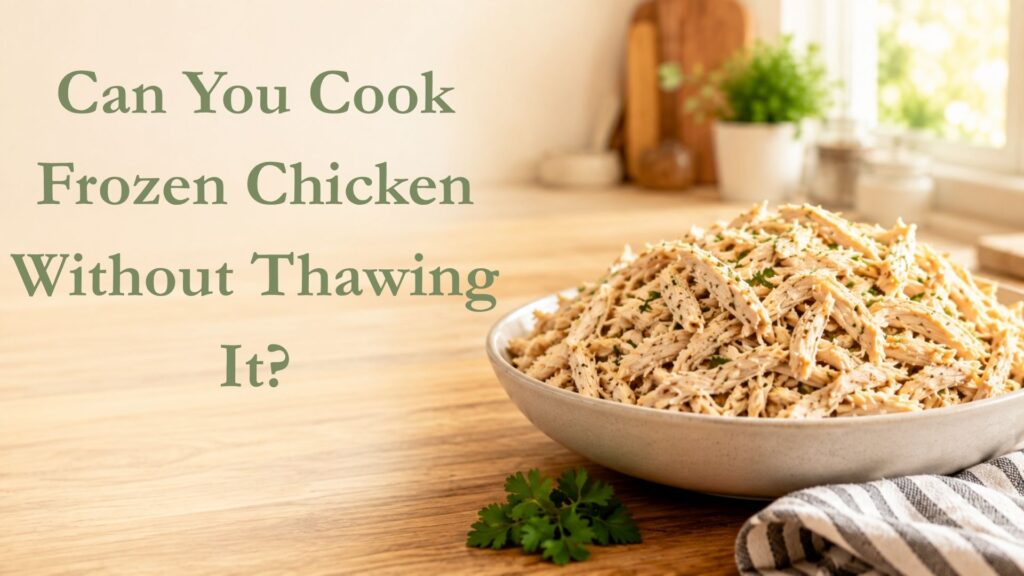
The main challenge is the temperature difference between the outside and center. The surface begins cooking while the center may still contain ice, so controlling heat and checking internal temperature matter more than following one fixed cooking time.
This temperature difference is central to cooking frozen chicken specifically for shredding, because the meat needs to become fully cooked without leaving the outer fibers unnecessarily dry before the center catches up.
What Happens When Chicken Cooks From Frozen?
Chicken muscle contains bundles of protein fibers with water distributed throughout the tissue. When the chicken is frozen, much of that water becomes ice.
Before the center can reach normal cooking temperatures, incoming heat must warm the frozen tissue and melt that ice. This adds time compared with chicken that begins refrigerated or fully thawed.
Once the center warms, the muscle proteins tighten and the connective structures between the fiber bundles begin changing. When sufficiently cooked, those bundles can separate into the strands needed for shredded chicken.
Which Cooking Methods Work From Frozen?
| Method | Suitable from frozen? | Typical shred texture | Main trade-off |
|---|---|---|---|
| Gentle simmering | Yes | Moist, medium strands | Longer cooking time |
| Pressure cooker | Yes | Soft, easy-to-separate strands | Less visual control during cooking |
| Oven | Yes | Firmer, defined strands | Exterior can dry while center catches up |
| Slow cooker | Not a good direct-from-frozen choice | Potentially soft | Chicken may spend too long heating gradually |
| Stovetop pan | Limited | Firm | Thick frozen centers cook unevenly |
Frozen Chicken Usually Needs More Time
A useful planning estimate is that frozen chicken may need roughly 50 percent more cooking time than a similar thawed piece. That is only a starting point because thickness, bone, cooking method, batch size, and whether pieces are stuck together can change the actual time substantially.
| Variable | Likely effect | Why |
|---|---|---|
| Thin boneless piece | Smaller time increase | Heat has a shorter path to the center |
| Thick breast | Larger time increase | Frozen center remains cold longer |
| Bone-in piece | Usually longer | Shape and thickness are less uniform |
| Pieces frozen separately | More predictable | Heat reaches the full exterior |
| Pieces frozen together | Less predictable | Inner surfaces remain insulated |
Do Not Treat a Frozen Block Like Separate Pieces
Several breasts or thighs frozen together form one thick cold mass. Heat cannot circulate between the pieces until enough ice melts for them to separate.
If the pieces loosen early in cooking, separate them with tongs and continue cooking them individually. If they remain a dense block, thawing first gives better control over how evenly the chicken cooks.
How to Cook Frozen Chicken for Shredding
- Remove all packaging from the frozen chicken.
- Separate individual pieces if they can be separated easily.
- Choose a cooking method that can heat the frozen center reliably.
- Allow more cooking time than you would for thawed chicken.
- Begin temperature checks before the estimated finish time.
- Check the thickest part and continue cooking until it reaches at least 165°F (74°C).
- Rest the cooked chicken for about 5 minutes.
- Shred while the meat is still warm.
Why Temperature Matters More Than Appearance
The outside can become opaque, firm, and visibly cooked while the center is still much cooler. That difference is larger with frozen chicken than with thawed chicken.
An instant-read thermometer gives a much clearer decision point. The same check is essential for telling when frozen chicken has cooked fully through, particularly with large breasts or irregular bone-in pieces.
Does Frozen Chicken Shred Differently?
Once fully cooked, previously frozen chicken still separates along its muscle-fiber bundles. The main difference is often moisture distribution rather than the shredding mechanism itself.
The longer heating period gives the exterior more opportunity to lose moisture. At the same time, melting ice and cooking juices can create visible liquid around the chicken, so the meat can appear wet while some individual fibers still feel comparatively dry.
Why Cooking Method Changes the Final Texture
Moist methods surround the chicken with hot liquid or steam, while oven cooking exposes the exterior to drier heat. Pressure cooking raises the cooking temperature and transfers heat efficiently, which can soften the fibers rapidly once the frozen center has warmed.
For fast bulk prep, pressure cooking frozen chicken for shredding can reduce hands-on time compared with waiting for a pot to simmer through thick frozen pieces.
Best Shredding Tools After Cooking From Frozen
| Tool | Typical time | Texture | Effort | Drawback |
|---|---|---|---|---|
| Two forks | 2 to 5 minutes | Medium, controlled | Medium | Slower for large batches |
| Hands | 1 to 4 minutes | Coarse to medium | Medium | Chicken must cool enough to handle |
| Hand mixer | 30 to 60 seconds | Fine | Low | Wet or soft chicken can over-shred quickly |
| Stand mixer | 20 to 60 seconds | Fine to medium | Low | Extra bowl cleanup |
| Shredder bowl | 30 to 90 seconds | Short, controlled | Low | Excess surface liquid should be drained first |
Best Uses for Chicken Cooked From Frozen
- Tacos: medium shreds absorb sauce while retaining texture.
- Soup: minor surface-moisture differences matter less once the chicken returns to broth.
- Casseroles: fine to medium shreds distribute evenly through sauce.
- Meal prep: useful when chicken was not thawed ahead of time.
- Wraps: drain excess liquid before filling to avoid soggy tortillas.
Common Mistakes
- Using thawed-chicken timing: the frozen center needs additional heating time.
- Relying on surface color: the exterior can cook well before the center.
- Cooking one solid frozen block: pieces cook more predictably when separated.
- Leaving small finished pieces with larger pieces: remove pieces individually when possible.
- Shredding in pooled liquid: excess liquid can make fillings and salads watery.
Best Working Rule
Frozen chicken can go directly into an appropriate cooking method without thawing. Give the frozen center extra time to heat, use internal temperature rather than appearance as the finish test, confirm at least 165°F (74°C), rest for about 5 minutes, and shred while warm.