
"As an Amazon Associate, I earn from qualifying purchases. This helps support this site at no extra cost to you."
You can shred chicken immediately after poaching, but it is usually better to let it rest for about 5 minutes first. Chicken shreds most easily while it is still warm, but heavily steaming meat is harder to handle and can release more moisture during shredding.
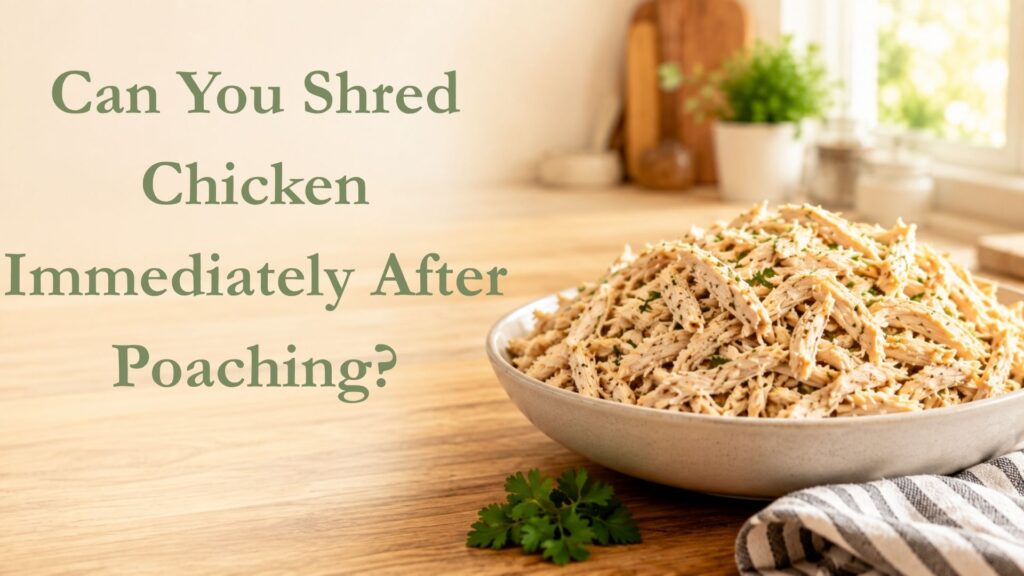
With a controlled poaching method for shredded chicken, the useful working point is warm but no longer aggressively steaming. At that stage, the muscle fibers are still relaxed enough to separate with relatively little force.
Why Warm Chicken Shreds More Easily
Cooked chicken is made of bundles of muscle fibers held together by connective structures. Heat changes those proteins and weakens enough connective tissue for the meat to pull apart.
While the chicken remains warm, those bundles separate with less resistance. As the meat cools, the proteins firm and the juices become less fluid, so chilled chicken normally requires more force to shred.
Why Waiting a Few Minutes Helps
Chicken coming directly from hot poaching liquid carries substantial surface heat and steam. Starting immediately can make fork handling awkward and makes hand shredding impractical.
A short rest allows the surface temperature to fall while the center remains warm. It also reduces the rush of juices that can appear when the chicken is pulled apart immediately.
Best Resting Time Before Shredding
| Resting time | Chicken condition | Shredding result | Main drawback |
|---|---|---|---|
| 0 to 1 minute | Very hot, heavily steaming | Fibers separate easily | Difficult and potentially unsafe to handle |
| About 5 minutes | Warm, less steaming | Easy, moist shredding | Minimal |
| 10 to 20 minutes | Warm to lukewarm | Still easy to shred | Fibers begin firming |
| Fully chilled | Cold and firm | More resistance | Greater effort |
How to Shred After a Short Rest
- Remove the fully cooked chicken from the poaching liquid.
- Place it on a clean plate, board, or shallow bowl.
- Let it rest for about 5 minutes.
- Check that it is manageable for the tool you intend to use.
- Pull the meat apart with forks, hands, a mixer, or a shredder bowl.
- Stop as soon as the shred size matches the intended dish.
- Add reserved poaching liquid or seasoning if needed.
Best Tool Based on Chicken Temperature
| Tool | Best chicken temperature | Approximate time | Texture | Trade-off |
|---|---|---|---|---|
| Two forks | Hot to warm | 2 to 4 minutes | Medium, controlled | More hand effort |
| Hands | Warm enough to handle safely | 1 to 3 minutes | Coarse to medium | Requires more cooling |
| Hand mixer | Warm | 30 to 60 seconds | Fine | Easy to over-shred |
| Stand mixer | Warm | 20 to 60 seconds | Fine to medium | Extra cleanup |
| Shredder bowl | Warm | 30 to 90 seconds | Short, controlled | Separate tool required |
What Happens if You Shred Too Hot?
The fibers will generally separate easily, but the chicken may be uncomfortable to handle and steam can make the work area wetter. Pulling very hot chicken apart also exposes more hot surface area immediately, allowing moisture to evaporate faster.
This does not mean you need a long cooling period. A short rest normally provides enough temperature drop without letting the meat become firm.
What Happens if You Wait Until the Chicken Is Cold?
Cold poached chicken can still be shredded, but the fibers resist separation more. Fork shredding takes longer and hand pulling requires more pressure.
If you are deliberately preparing the chicken for later use, keeping it intact during refrigeration can help limit exposed surface area. The trade-off is that shredding later requires more effort.
How Moisture Changes During Resting
Resting does not make overcooked chicken moist again. Its main advantage is allowing the temperature and juices inside correctly cooked meat to stabilize before you tear open thousands of fiber surfaces.
Starting with properly cooked meat remains more important, so techniques that keep poached chicken moist should be applied during the cooking stage rather than relying on resting alone.
Should You Add Poaching Liquid While Shredding?
If the chicken looks moist, there is no need to add liquid. If the strands appear slightly dry, toss them with a small amount of reserved warm poaching liquid after shredding.
Add a little at a time. The goal is lightly coated fibers rather than liquid pooling at the bottom of the bowl.
Best Timing by Use Case
- Tacos: shred after about 5 minutes for moist medium strands that take seasoning easily.
- Chicken salad: allow the chicken to cool somewhat longer before mixing with chilled ingredients.
- Soup: shred while warm and return the chicken near the end of preparation.
- Meal prep: shred warm, cool promptly, and refrigerate in portions.
- Bulk prep: process pieces in batches so they do not all become cold before shredding.
Common Timing Mistakes
- Handling the chicken immediately with bare hands: freshly poached meat can be too hot to handle safely.
- Waiting until completely cold unintentionally: cold fibers require more shredding effort.
- Leaving chicken in the hot poaching liquid while waiting: residual heat can continue cooking the meat.
- Over-processing warm chicken with a mixer: soft fibers can become very fine within seconds.
If the chicken is being prepared well ahead of use rather than shredded immediately, the way you store poached chicken for later shredding becomes more important than squeezing the shredding step into the cooking session.
Best Working Time
Let freshly poached chicken rest for about 5 minutes, then shred while it is warm but no longer heavily steaming. This gives a practical balance between easy fiber separation, manageable handling, and moisture control.