
"As an Amazon Associate, I earn from qualifying purchases. This helps support this site at no extra cost to you."
Frozen chicken can be cooked in liquid on the stovetop, but poaching it directly from frozen takes longer and gives you less control over texture than starting with thawed chicken. Individual frozen pieces are much easier to handle safely and evenly than several pieces frozen into one solid block.
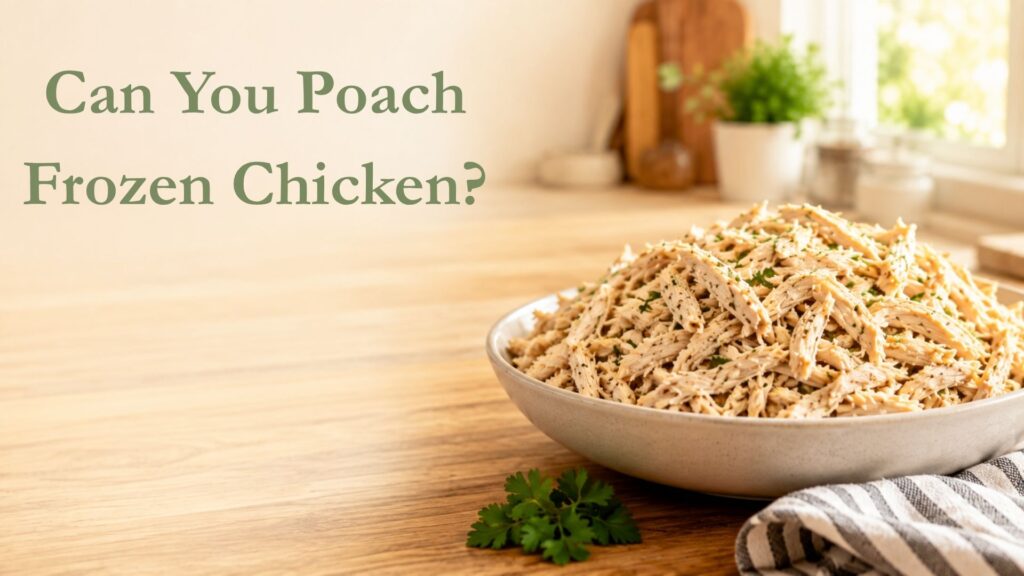
The basic principles of poaching chicken for shredding still apply: use controlled heat, allow enough time for the center to warm completely, and verify doneness in the thickest part before shredding.
Why Frozen Chicken Takes Longer to Poach
Frozen chicken begins well below the temperature of refrigerated chicken. Heat entering the meat must first warm the frozen tissue and melt ice before the center can progress normally through the cooking range.
Meanwhile, the exterior is already surrounded by hot liquid. This creates a larger temperature difference between the surface and center than you get with thawed chicken.
If the liquid is too hot, the outer muscle fibers may tighten and lose moisture while the center is still thawing. Maintaining the right poaching temperature becomes particularly important when the chicken starts frozen.
Frozen Chicken Poaching Time
| Frozen chicken | Approximate cooking range | Main variable |
|---|---|---|
| Small boneless breast | 18 to 25 minutes | Thickness |
| Average boneless breast | 20 to 30 minutes | Center temperature |
| Large boneless breast | 25 to 35 minutes or longer | Thickness through center |
| Boneless thighs | 20 to 30 minutes | Piece size |
| Bone-in pieces | 30 minutes or longer | Bone and overall thickness |
These ranges are useful only for deciding when to begin checking. Frozen chicken varies too much in thickness and shape for time alone to establish doneness.
How to Poach Individual Frozen Chicken Pieces
- Place individually frozen pieces in a pot with enough room for liquid to circulate around them.
- Add enough cool water or broth to surround and cover the chicken.
- Heat the pot gradually over medium heat.
- As the liquid becomes hot, reduce the burner as needed to prevent a rolling boil.
- If two pieces are lightly frozen together, separate them with tongs once the ice loosens naturally.
- Begin checking the thickest pieces near the lower end of the expected time range.
- Verify that the center is fully cooked before removing the chicken.
- Rest for about 5 minutes and shred while still warm.
Do Not Treat a Frozen Block Like Individual Pieces
Several breasts frozen into one solid mass behave very differently from separate frozen breasts. Hot liquid cannot circulate between the pieces, and the center of the block remains cold for much longer.
Thawing a dense block before poaching provides more predictable results. If the pieces are only lightly stuck together, they may separate naturally as the outer ice melts, but do not force them apart with a knife while they are hard and frozen.
How to Know Frozen Chicken Is Fully Cooked
The exterior can look opaque and cooked well before the center is ready, so appearance is particularly unreliable with chicken that started frozen.
Check the thickest central section with a thermometer rather than judging only by color or elapsed time. The same principle is important when determining when poached chicken is done, regardless of whether it began frozen or thawed.
How Frozen Chicken Affects Shredding Texture
Once fully cooked, frozen chicken can separate into muscle fibers much like chicken that began thawed. The main difference comes from the longer heating period.
If the exterior spends too long at high temperature, the outside can become firmer and drier than the center. Shredding may then produce a mixture of moist interior strands and slightly stringier outer strands.
Best Tools After Poaching From Frozen
| Tool | Approximate time | Result | Effort | Drawback |
|---|---|---|---|---|
| Two forks | 2 to 5 minutes | Controlled medium shreds | Medium | Slower |
| Hands | 2 to 4 minutes | Coarse natural strands | Medium | Requires cooling first |
| Hand mixer | 30 to 60 seconds | Fine shreds | Low | Can over-process dry outer sections |
| Stand mixer | 20 to 60 seconds | Fine to medium | Low | Less direct texture control |
| Shredder bowl | 30 to 90 seconds | Short, fairly even shreds | Low | Additional cleanup |
Common Mistakes With Frozen Chicken
- Using thawed-chicken timing: the frozen center requires extra heating time.
- Turning up the heat to compensate: hotter liquid cooks the exterior more aggressively without instantly warming the center.
- Cooking a solid frozen block: the center heats far more slowly than exposed pieces.
- Checking only one small piece: larger pieces in the same pot may still need more time.
- Relying on color: an opaque exterior does not prove the thickest center is finished.
When Thawing First Is Better
Thaw first when the chicken pieces are unusually thick, bone-in, frozen together, or being prepared in a large batch. Refrigerator-thawed chicken gives you a narrower center-to-surface temperature difference and therefore more control over final moisture.
Direct-from-frozen poaching is most practical for individually frozen boneless pieces when convenience matters more than precise texture control.
Best Working Approach
You can poach individual frozen chicken pieces, but expect them to take substantially longer than thawed chicken. Keep the liquid gentle, check the thickest pieces individually, and avoid using a hard boil to make up for the frozen starting temperature.