
"As an Amazon Associate, I earn from qualifying purchases. This helps support this site at no extra cost to you."
Chicken breast is one of the most practical cuts for shredding because it produces lean, distinct fibers that work well in tacos, salads, soups, sandwiches, casseroles, and meal prep. The quality of the final shreds depends less on the shredding tool itself and more on how the breast is cooked, rested, and handled before the fibers are pulled apart.
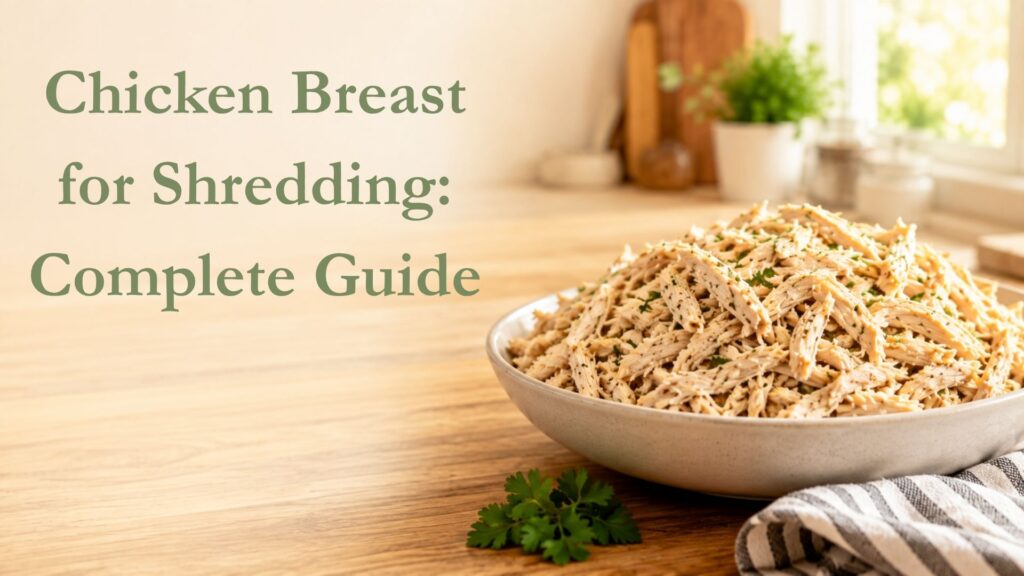
The best results usually come from controlled cooking that fully cooks the center without driving excessive moisture from the muscle fibers. Once cooked, a short rest of about 5 to 10 minutes followed by shredding while the meat is still warm gives a useful balance between easy separation and moisture retention.
The exact method changes with breast size, whether the meat is fresh or frozen, whether bone is present, how much chicken you need, and whether you want coarse strands or fine shreds. Understanding those variables makes the process more predictable than relying on one fixed cooking time or one shredding tool.
How Chicken Breast Shreds
Chicken breast is made of long bundles of muscle fibers held together by connective tissue. During cooking, heat causes proteins inside those fibers to tighten while connective structures soften enough for the bundles to separate.
The useful shredding window appears after the chicken is fully cooked but before excessive heating has driven out too much moisture. At that stage, the meat feels firm but not hard, juices are not heavily pooling, and the fibers pull apart with moderate pressure.
If the breast is undercooked, the center can feel dense or rubbery. If it is overcooked, the fibers may still separate but can become dry, stiff, or stringy. That balance is why making chicken breast easy to shred starts with cooking control rather than simply choosing a stronger tool.
Best Way to Cook Chicken Breast for Shredding
Gentle poaching, covered skillet cooking, carefully controlled baking, pressure cooking, and slow cooking can all produce good shredded chicken. For a small to medium batch, gentle stovetop poaching is often the easiest method to control because the surrounding liquid transfers heat evenly while limiting surface drying.
The key is avoiding aggressive boiling. A hard rolling boil heats the exterior rapidly and can tighten the outer proteins before the center finishes cooking. A gentle simmer produces a more even temperature gradient and usually makes the finished fibers easier to pull apart.
For most everyday kitchens, gentle cooking methods for shredded chicken breast offer the best combination of moisture control, low cleanup, and predictable texture.
Chicken Breast Cooking Methods Compared
| Cooking method | Typical timing | Shredding result | Best use | Main drawback |
|---|---|---|---|---|
| Gentle poaching | About 12 to 18 minutes for many boneless breasts | Moist, medium strands | General meal prep | Hard boiling can toughen the exterior |
| Covered skillet | About 12 to 18 minutes | Moist, controlled texture | Small batches | Needs heat monitoring |
| Oven baking | About 20 to 30 minutes | Firm, clean strands | Several breasts at once | Greater drying risk |
| Pressure cooker | Short pressure cycle plus release | Very easy to separate | Fast bulk prep | Easy to over-soften |
| Slow cooker | Several hours | Very soft shreds | Saucy dishes | Lean breast can dry with excessive cooking |
How Long to Cook Chicken Breast for Shredding
Cooking time depends more on thickness than on the number of breasts in the pan. Two pieces of equal weight can finish at different times if one is flatter and the other is unusually thick.
As a practical planning range, medium boneless breasts often need about 12 to 18 minutes during gentle poaching and roughly 20 to 30 minutes when baked. Those numbers should tell you when to begin checking, not guarantee doneness.
Breast thickness, starting temperature, bone, cooking method, and equipment all change how long chicken breast needs to cook before shredding.
Why Resting Makes Shredding Easier
Chicken continues changing briefly after it leaves the heat. Carryover cooking settles, strong steaming slows, and juices redistribute through the muscle.
A rest of roughly 5 to 10 minutes usually leaves the chicken warm enough for flexible fibers but cool enough to handle more comfortably. Shredding immediately can release more visible steam and moisture, while waiting until the meat is refrigerator-cold makes the fibers firmer.
Best Tools for Shredding Chicken Breast
| Tool | Approximate time | Texture | Effort | Main drawback |
|---|---|---|---|---|
| Hands | 2 to 5 minutes | Coarse to medium | Medium | Chicken must cool enough to touch safely |
| Two forks | 2 to 6 minutes | Medium, irregular | Medium to high | Slow for large batches |
| Hand mixer | 30 to 90 seconds | Fine, short | Low | Easy to over-shred |
| Stand mixer | 30 to 90 seconds | Fine to medium | Low | More equipment cleanup |
| Shredder bowl | 30 seconds to several minutes | Short, fairly uniform | Low | May need multiple loads |
Tool choice affects speed and texture, but it cannot compensate for poorly cooked meat. Warm, properly cooked chicken separates readily with almost any suitable method.
Boneless vs Bone-In Chicken Breast for Shredding
Boneless breast is usually the simpler choice because it cooks faster, requires no deboning step, and can move directly from resting to shredding.
Bone-in breast is typically thicker and may retain skin during cooking, which can change moisture behavior and extend cooking time. It also adds several minutes of handling because the meat must be separated from bone and checked for cartilage before shredding.
The choice between boneless and bone-in chicken breast for shredding is therefore mainly about convenience, cooking time, and preparation rather than a completely different final fiber structure.
Fresh vs Frozen Chicken Breast
Fresh or fully thawed chicken is easier to cook predictably because the center starts much closer to cooking temperature. Frozen chicken requires additional energy to warm the meat and melt ice before its center can continue heating normally.
This longer heating period means the outside can spend considerably more time exposed to heat, especially if the breast is thick. Aggressive cooking increases the chance that the outer fibers become dry before the center is ready.
For planned meal prep, fresh or fully thawed chicken breast gives more predictable shredding results, while frozen meat can still work when the cooking method accommodates the colder center.
How Much Shredded Chicken Does One Breast Make?
A medium cooked chicken breast often produces about 1 cup of shredded chicken, but breast size varies too much for that to be an exact conversion.
A small breast may produce around 1/2 to 3/4 cup. A large breast can yield 1 to 1 1/2 cups or more. Measuring cooked weight is more reliable than assuming every piece produces one cup.
A useful working reference is about 125 to 140 grams of moderately shredded cooked chicken per cup. That range helps explain why the shredded yield from one chicken breast varies so widely.
How Many Breasts Make 2 Cups of Shredded Chicken?
For two cups, start with about two medium boneless chicken breasts. One unusually large breast may be enough, while two or three small pieces may be needed.
For better repeatability, aim for about 250 to 280 grams of cooked shredded meat. That gives a more dependable target than piece count when preparing two cups of shredded chicken from whole breasts.
How Many Breasts Make 3 Cups?
Three medium breasts are a practical starting point for three cups. Large pieces can reduce the count to two, while small breasts may push it to three or four.
A cooked-weight target of roughly 375 to 420 grams is more consistent. Shred size and packing pressure still matter because coarse fibers occupy more space than fine shreds.
That size variation is why three cups of shredded chicken cannot be predicted from breast count alone.
How Many Breasts Make 4 Cups?
Four medium breasts will usually put you close to four cups of shredded chicken. Two or three large breasts may be sufficient, while very small pieces may require four to five.
At this batch size, cooked weight becomes especially useful because small differences accumulate across several pieces. About 500 to 560 grams of cooked chicken is a practical reference.
For larger family meals or meal prep, four cups of shredded chicken is easier to plan by cooked weight than by assuming every breast contributes the same amount.
Why Shred Size Changes Cup Measurements
Shredding changes the amount of space the chicken occupies without meaningfully changing its mass. Long fibers overlap and trap air. Fine fibers settle into those gaps and create a denser cup.
| Shred texture | Packing behavior | Likely cup weight | Best use |
|---|---|---|---|
| Coarse | Loose, airy | Lower | Salads, sandwiches |
| Medium | Moderate | Good general reference | Tacos, soup, meal prep |
| Fine | Dense | Higher | Casseroles, fillings |
| Compressed | Very dense | Highest | Only when a recipe specifies packing |
Why Chicken Breast Can Be Hard to Shred
Difficult shredding usually points to temperature, doneness, or moisture. Undercooked meat can feel dense and rubbery. Overcooked chicken often feels dry, stiff, and stringy. Refrigerator-cold breast can simply be firmer because the muscle fibers have tightened during cooling.
The first step is diagnosing the type of resistance rather than pulling harder. That distinction helps determine why a chicken breast is resisting the shredding process.
How to Keep Shredded Chicken Breast Tender
Tenderness is easiest to preserve during cooking. Once the muscle proteins have tightened excessively and expelled moisture, adding liquid afterward improves the finished dish but cannot completely reverse the structural change.
Cook gently, remove the breast promptly once fully cooked, rest it for 5 to 10 minutes, and avoid shredding finer than the dish requires. After shredding, a small amount of warm broth, cooking liquid, or sauce can coat the fibers and limit surface drying.
Keeping the chicken covered also matters because shredded meat exposes much more surface area to air. These steps are central to keeping shredded chicken breast tender after cooking.
Chicken Breast vs Chicken Thigh for Shredding
Chicken breast and thigh can both shred well, but they produce different outcomes. Breast gives leaner, cleaner, more distinct strands. Thigh gives softer, richer, and generally more moisture-tolerant shreds.
Breast is particularly useful for chicken salad, sandwiches, soups, wraps, and flexible meal prep. Thigh often performs better in tacos, slow-cooked fillings, and saucy dishes where longer heating or reheating is expected.
The trade-off between chicken breast and chicken thigh for shredding is therefore mainly about lean structure versus cooking forgiveness.
Best Method by Use-Case
| Use-case | Cooking approach | Shred texture | Useful tool |
|---|---|---|---|
| Tacos | Poached, pressure cooked, or covered skillet | Medium | Forks, hands, or mixer briefly |
| Chicken salad | Poached or gently baked | Coarse to medium | Hands or forks |
| Soup | Poached or cooked in broth | Medium | Forks |
| Sandwiches | Poached or baked | Medium to long | Hands or forks |
| Meal prep | Poached, baked, or pressure cooked | Medium | Stand mixer for larger batches |
| Casseroles | Any controlled moist method | Fine to medium | Mixer or forks |
Step-by-Step Chicken Breast Shredding Method
- Choose breasts of similar thickness where possible.
- Use a cooking method that avoids unnecessary moisture loss.
- Cook until the thickest part is fully cooked rather than relying only on the clock.
- Remove smaller pieces first if they finish before thicker breasts.
- Rest the cooked chicken for about 5 to 10 minutes.
- Shred while the meat is warm but no longer releasing heavy steam.
- Use forks or hands for texture control, or a mixer when speed matters.
- Stop once the desired shred size is reached.
- Add a small amount of suitable warm liquid if the finished chicken needs more moisture.
- Keep the shreds covered until serving or storage.
Common Mistakes With Chicken Breast for Shredding
- Using aggressive heat: the exterior can tighten before the center finishes cooking.
- Cooking by time alone: thickness can change timing substantially.
- Leaving cooked chicken on the heat: continued heating increases moisture loss.
- Shredding immediately: very hot chicken can release more steam and liquid.
- Waiting until refrigerator-cold: the fibers become firmer and require more force.
- Overusing powered tools: correctly cooked chicken can move from strands to tiny fragments in seconds.
- Compressing cup measurements: tightly packed chicken contains much more meat than loosely filled cups.
- Leaving shredded chicken uncovered: the exposed fibers can dry quickly.
If the Chicken Is Too Hot, Too Cold, Too Wet, or Too Dry
| Problem | What to do | Expected outcome |
|---|---|---|
| Too hot | Rest another few minutes | Safer handling and less heavy steaming |
| Too cold | Warm gently with a little liquid if appropriate | More flexible fibers |
| Too wet | Move meat out of pooled liquid before shredding | Better tool control |
| Too dry | Shred coarsely and add warm liquid gradually | Improved eating texture |
| Rubbery | Check whether the center needs more cooking | Properly cooked fibers separate more easily |
Storing Shredded Chicken Breast
Shredded chicken dries faster than whole cooked breast because the fibers expose much more surface area. Store it covered and retain a small amount of suitable moisture when the intended dish allows it.
For meal prep, medium shreds are usually the most flexible. They can later be used in soup, tacos, salads, wraps, or casseroles without breaking down as quickly as extremely fine strands.
Best Practical Chicken Breast Shredding Rule
The most predictable process is simple: cook chicken breast gently until fully done, rest it for about 5 to 10 minutes, and shred while warm. Use medium strands as the default texture unless the dish specifically benefits from coarser or finer pieces.
For quantities, use breast count only as a quick estimate. A medium breast often yields around one cup, but cooked weight gives much better consistency when preparing larger batches.
Most shredding problems can be traced back to one of the same variables: too much heat, too little cooking, excessive moisture loss, cooling too far before shredding, or choosing a tool that produces a finer texture than the dish needs.