
"As an Amazon Associate, I earn from qualifying purchases. This helps support this site at no extra cost to you."
Frozen chicken can be cooked for shredding without thawing first when you use a method that can heat the center reliably. Simmering, pressure cooking, and oven cooking can all work. The key is to allow extra cooking time, confirm that the thickest part reaches at least 165°F (74°C), rest the chicken briefly, and shred it while still warm.
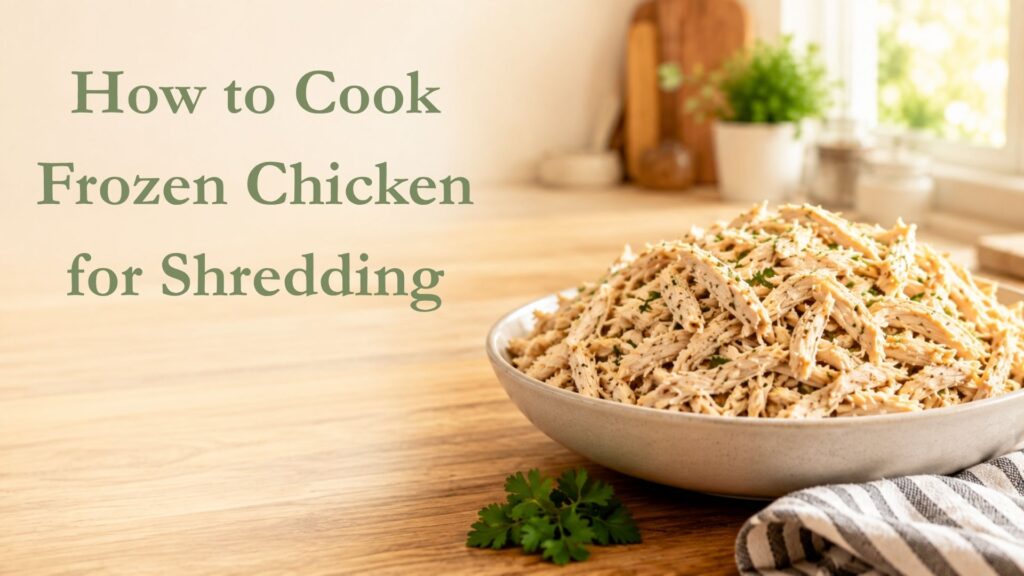
Frozen chicken usually takes longer than comparable thawed chicken because the center begins below freezing. Heat must first warm the frozen tissue and melt internal ice before the center can continue toward full cooking temperature.
The practical goal is not simply to cook the chicken through. For good shredding, you want the muscle fibers fully cooked and easy to separate without leaving the exterior unnecessarily dry while the frozen center catches up.
Quick Method for Cooking Frozen Chicken to Shred
- Remove all packaging from the frozen chicken.
- Separate individual pieces if they can be separated easily.
- Choose simmering, pressure cooking, or oven cooking depending on the texture and timing you want.
- Allow substantially more cooking time than you would for thawed chicken.
- Begin checking the largest or thickest piece before the expected finish time.
- Confirm at least 165°F (74°C) in the thickest section.
- Remove the chicken from excess cooking liquid.
- Rest it for about 5 minutes.
- Shred while the chicken is warm but no longer heavily steaming.
Can You Cook Frozen Chicken Without Thawing?
Yes. Thawing makes cooking faster and more predictable, but it is not required for every cooking method. Individual frozen pieces can go directly into methods that transfer enough heat to the center.
The main limitation is the center-to-surface temperature gap. The outside begins cooking immediately, while the center may still contain ice. Understanding when frozen chicken can be cooked without thawing helps you choose a method that can manage that difference rather than simply extending any recipe blindly.
How Frozen Chicken Changes During Cooking
Chicken muscle consists of long bundles of protein fibers containing a large amount of water. When chicken freezes, part of that water becomes ice.
During cooking, heat first warms the frozen tissue and melts the ice. As temperature rises further, muscle proteins tighten and connective structures change. Once the meat is fully cooked, those bundles can separate along their natural grain into shreds.
The challenge is that outer fibers may spend considerably longer exposed to heat than the center. That is why heat control and temperature checking matter more with frozen chicken than with thawed chicken.
Best Cooking Methods for Frozen Chicken
| Method | Direct from frozen? | Typical texture | Hands-on effort | Main trade-off |
|---|---|---|---|---|
| Gentle simmer | Yes | Moist, medium strands | Moderate | Requires monitoring |
| Pressure cooker | Yes | Soft, easy-to-shred strands | Low | Less visual control |
| Oven | Yes | Firmer, defined strands | Low | Exterior can dry |
| Slow cooker | Better after thawing | Soft, moist | Very low | Frozen chicken heats too gradually |
Can You Boil Frozen Chicken for Shredding?
Yes. Individual frozen breasts or thighs can be cooked in water or broth. Bring the liquid toward a boil, then reduce it to a gentle simmer rather than keeping the pot at a hard rolling boil.
Boneless frozen breasts may need roughly 20 to 30 minutes of simmering, while thick or bone-in pieces can take longer. The practical method for boiling frozen chicken for shredding works best when pieces are separated so hot liquid can circulate around them.
Why a Gentle Simmer Works Better
A rolling boil exposes the exterior to aggressive heat while the frozen center is still warming. That can tighten the outside proteins sooner than necessary and increase moisture loss.
A gentle simmer provides a steadier transfer of heat toward the center. Small, consistent bubbles are enough to cook the chicken without violently moving it around the pot.
Can You Pressure Cook Frozen Chicken?
Pressure cooking is one of the fastest low-effort approaches for frozen chicken. The sealed cooker traps steam and raises the cooking temperature, allowing heat to move efficiently through the frozen meat.
Many boneless frozen breasts need roughly 10 to 15 minutes at high pressure, but total kitchen time also includes the time required to build pressure and release it afterward. For bulk meal prep, pressure cooking frozen chicken for shredding is particularly useful when speed matters more than watching each piece individually.
Pressure Cooking Trade-Offs
| Advantage | What it means in practice |
|---|---|
| Fast active cooking | Useful for thick frozen pieces |
| Moist environment | Chicken usually shreds easily |
| Low monitoring | No need to watch a simmer |
| Less visual control | You cannot remove individual pieces mid-cycle |
| Soft texture | Easy to over-process with a mixer |
Can You Slow Cook Frozen Chicken?
For a slow cooker, thawing first is the better approach. Slow cookers are designed to warm food gradually over several hours, which makes them poorly suited to thick chicken that begins solidly frozen.
If slow-cooked shredded chicken is the goal, thaw the pieces first and then use the slow cooker. The distinction matters because slow cooking frozen chicken for shredding creates a much slower center-heating path than simmering, pressure cooking, or oven cooking.
Can You Bake Frozen Chicken?
Yes. A preheated oven can cook frozen chicken directly, although the process usually takes considerably longer than baking thawed chicken.
Baking produces relatively firm, defined strands, but the exterior can dry while the center warms. Using a covered dish for part of the cooking period or adding a small amount of broth can create a more humid environment.
For hands-off cooking with more defined fibers, baking frozen chicken for shredding provides a useful alternative to wet stovetop methods.
How Long Does Frozen Chicken Take to Cook?
A practical planning assumption is that frozen chicken may take roughly 50 percent longer than comparable thawed chicken. That is only a starting point rather than a fixed rule.
| Cooking method | Typical frozen boneless breast range | Extra time to include |
|---|---|---|
| Gentle simmer | 20 to 30 minutes | Heating the pot |
| Pressure cooker | 10 to 15 minutes at pressure | Pressure build and release |
| Oven | 35 to 50 minutes | Preheating |
| Slow cooker | Thaw first | Long slow-cook cycle |
Thickness, bone, batch size, starting freezer temperature, and whether pieces are frozen separately all influence the finish time. This is why frozen chicken cooking time for shredding is best treated as a range for deciding when temperature checks should begin.
Thickness Matters More Than Weight Alone
A broad, thin breast may cook faster than a compact thick breast even if both weigh nearly the same. Heat has a shorter distance to travel to reach the center of the thinner piece.
When batch cooking, pieces of similar thickness finish more predictably and reduce the need to keep smaller pieces heating while a very thick piece catches up.
Do Not Cook a Dense Frozen Block Like Individual Pieces
Several breasts frozen together effectively form one large cold mass. The cooking method cannot reach the surfaces trapped in the center until enough ice melts for the pieces to separate.
If they loosen early, separate them with tongs and continue cooking. If they remain tightly fused, thawing first gives a more predictable result.
Frozen Chicken Breast vs Fresh Chicken
Frozen and fresh chicken breast can both produce useful shredded chicken, but fresh or thawed chicken usually cooks more evenly and on a more predictable schedule.
Frozen chicken has the convenience advantage because it can move directly from freezer to cooking when thawing was forgotten. The comparison between frozen and fresh chicken breast for shredding is therefore less about whether either can shred and more about timing, moisture, and heat distribution.
| Factor | Frozen breast | Fresh or thawed breast |
|---|---|---|
| Cooking time | Longer | Shorter |
| Timing predictability | Lower | Higher |
| Visible liquid | Often more | Usually less |
| Heat distribution | Larger outside-center gap | More even |
| Final shredding potential | Good | Good |
What Temperature Should Frozen Chicken Reach?
Confirm that the thickest section reaches at least 165°F (74°C). Measure the meat itself, not the cooking liquid or the surface.
For bone-in pieces, position the thermometer in the thickest meat without pressing the probe directly against bone. If the batch contains very different sizes, test more than one piece.
How to Tell When Frozen Chicken Is Fully Cooked
Temperature is the primary check, but texture provides a useful secondary signal. Fully cooked chicken should feel firm but yielding, and the fibers should pull apart rather than stretch with rubbery resistance.
- Temperature: at least 165°F (74°C) in the thickest center.
- Fiber separation: cooked strands pull apart along the grain.
- Resistance: the center does not feel rubbery or elastic.
- Surface appearance: useful only as a supporting clue.
Because the surface can look finished long before the center, the most reliable approach to checking whether frozen chicken is fully cooked combines an instant-read thermometer with the way the fibers behave under fork pressure.
Why Frozen Chicken Can Become Watery
Previously frozen chicken often releases noticeable liquid during cooking. Some comes from melting ice, while more is pushed from the muscle tissue as heating proteins tighten.
This can make the chicken appear especially wet even when the fibers themselves are not unusually juicy. Free liquid around the meat and moisture retained inside the fibers are different things.
The amount of liquid depends heavily on the cooking method, which explains why frozen chicken may become watery after cooking in a covered baking dish or pressure cooker while uncovered oven cooking allows more moisture to evaporate.
How Cooking Method Changes Visible Liquid
| Method | Visible liquid | Main reason |
|---|---|---|
| Pressure cooker | High | Steam and liquid remain trapped |
| Simmering | Very high | Chicken is surrounded by liquid |
| Covered baking | Moderate to high | Released moisture evaporates slowly |
| Uncovered baking | Lower | More evaporation |
How to Drain Frozen Chicken Before Shredding
Remove cooked chicken from pooled liquid before shredding. Place it on a clean plate, shallow tray, rack, or in a colander and allow excess surface liquid to drain for about 1 to 2 minutes.
Do not squeeze the meat. Draining should remove free water without pressing useful internal moisture from the muscle fibers. The same distinction is central to draining frozen chicken before shredding without turning it dry.
Should You Rest Frozen Chicken Before Shredding?
Yes. A rest of about 5 minutes is useful after the chicken reaches temperature. The meat should remain warm but stop releasing heavy steam.
Warm fibers separate more easily than chilled fibers, while the short rest makes the chicken easier to handle and gives carryover heat time to settle.
Best Tools for Shredding Frozen-Then-Cooked Chicken
| Tool | Typical time | Texture | Mess | Main drawback |
|---|---|---|---|---|
| Two forks | 2 to 5 minutes | Medium, controlled | Low | More manual effort |
| Hands | 1 to 4 minutes | Coarse to medium | Medium | Chicken must cool enough |
| Hand mixer | 30 to 60 seconds | Fine | Medium | Easy to over-shred |
| Stand mixer | 20 to 60 seconds | Fine to medium | Low during mixing | Extra cleanup |
| Shredder bowl | 30 to 90 seconds | Short, controlled | Low | Drain excess liquid first |
How to Shred With Two Forks
- Place the warm chicken on a clean plate or shallow bowl.
- Hold one end steady with the first fork.
- Pull with the second fork in the direction of the muscle fibers.
- Rotate the chicken as necessary.
- Stop once the strands match the intended dish.
How to Shred With a Mixer
Use low speed and short bursts. Pressure-cooked chicken in particular can become very soft, so 20 to 60 seconds may be enough for an entire batch.
Drain obvious surface liquid first. Excess liquid in the mixing bowl can splash and can make it harder to judge the actual shred texture.
Best Shred Texture by Use
| Dish | Useful shred texture | Moisture level |
|---|---|---|
| Tacos | Medium | Lightly moist |
| Wraps | Medium | Well drained |
| Chicken salad | Medium | Well drained |
| Soup | Medium to coarse | Less draining needed |
| Casserole | Fine to medium | Moderate |
| Meal prep | Medium | Lightly moist |
Can You Shred Chicken After Thawing?
Yes, but raw thawed chicken should first be cooked fully. Once the thickest section reaches at least 165°F (74°C), let it rest briefly and shred while warm.
Previously cooked frozen chicken can also be thawed and shredded. If chilled fibers feel firm, warming the meat gently first makes pulling easier. For planned prep, shredding chicken after thawing can give more predictable cooking and texture than always working directly from frozen.
Thawed Chicken Is Easier to Schedule
Thawed chicken begins at a more uniform temperature, so the center does not lag as far behind the exterior. This shortens cooking time and makes batch timing easier.
Cooking from frozen remains useful when thawing was forgotten, but thawing first is often preferable when you have time and want tighter texture control.
Can Cooked Chicken Be Frozen Again?
Previously frozen raw chicken can generally be cooked and then frozen as cooked chicken, provided it has been handled, cooked, cooled, and stored appropriately.
For meal prep, shred first, divide into useful portions, retain only enough moisture to protect the strands, and freeze in airtight containers or freezer bags. The storage stage changes once the raw chicken has been fully cooked, which is why previously frozen chicken can be frozen again after cooking when the handling process has remained appropriate.
How to Freeze Cooked Shredded Chicken
- Cook the chicken fully.
- Drain excessive surface liquid.
- Shred while warm.
- Divide the chicken into meal-size portions.
- Cool appropriately before freezer storage.
- Add a small amount of broth if the strands need moisture.
- Seal in freezer-suitable airtight packaging.
- Label the portion so its storage history is easy to track.
Common Frozen-Chicken Shredding Mistakes
- Using thawed-chicken timing: frozen centers need more time.
- Relying on surface color: the exterior can look cooked before the center reaches temperature.
- Cooking a solid frozen block: separated pieces heat more predictably.
- Using a slow cooker directly from frozen: thawing first is the better approach.
- Leaving fully cooked chicken heating unnecessarily: extra time can dry the fibers.
- Shredding in pooled liquid: excess water can dilute sauces and fillings.
- Squeezing chicken dry: this can remove useful internal moisture.
- Over-processing pressure-cooked chicken: soft meat can become too fine within seconds.
If the Chicken Is Still Cold in the Center
Continue cooking. Do not judge the batch by the smaller pieces or the outside texture of the thickest breast.
When practical, remove pieces that have already reached temperature and continue cooking only the pieces that need more time.
If the Chicken Is Too Wet
Transfer it out of the cooking liquid and let the surface drain for 1 to 2 minutes. Shred first, then decide whether any of the cooking liquid needs to be mixed back in.
If the Chicken Is Too Dry
Shred it coarsely instead of creating very fine strands. Add roughly 1 tablespoon of warm broth or cooking liquid per cup of chicken, toss gently, and reassess before adding more.
If the Chicken Will Not Shred Easily
Check internal temperature first. If the meat is not fully cooked, continue heating it. If it has reached temperature but has become cold and firm, warming it gently can make the fibers easier to pull apart.
Best Method by Situation
| Situation | Best practical method | Why |
|---|---|---|
| Need minimal monitoring | Pressure cooker | Low hands-on effort |
| Want controlled medium shreds | Gentle simmer | Easy to check individual pieces |
| Want firmer strands | Oven | Drier heat gives more structure |
| Want slow-cooked texture | Thaw first, then slow cook | Better heating path |
| Meal prep for several dishes | Pressure cooker or simmer | Easy bulk cooking |
Best Working Method
For most freezer-to-shredded-chicken situations, cook individually frozen pieces by gentle simmering, pressure cooking, or oven cooking. Allow extra time for the frozen center, verify at least 165°F (74°C) in the thickest section, remove excess free liquid, rest for about 5 minutes, and shred while warm.
Use forks or hands when strand control matters, and a mixer or shredder bowl when speed matters more. The best finished texture is moist enough to remain flexible, dry enough not to water down the final dish, and cooked only long enough for the fibers to separate cleanly.