
"As an Amazon Associate, I earn from qualifying purchases. This helps support this site at no extra cost to you."
Frozen and fresh chicken breast can both produce good shredded chicken, but they behave differently during cooking. Fresh or fully thawed chicken usually cooks more evenly and predictably, while frozen chicken takes longer and may release more visible liquid as internal ice melts and muscle proteins tighten.
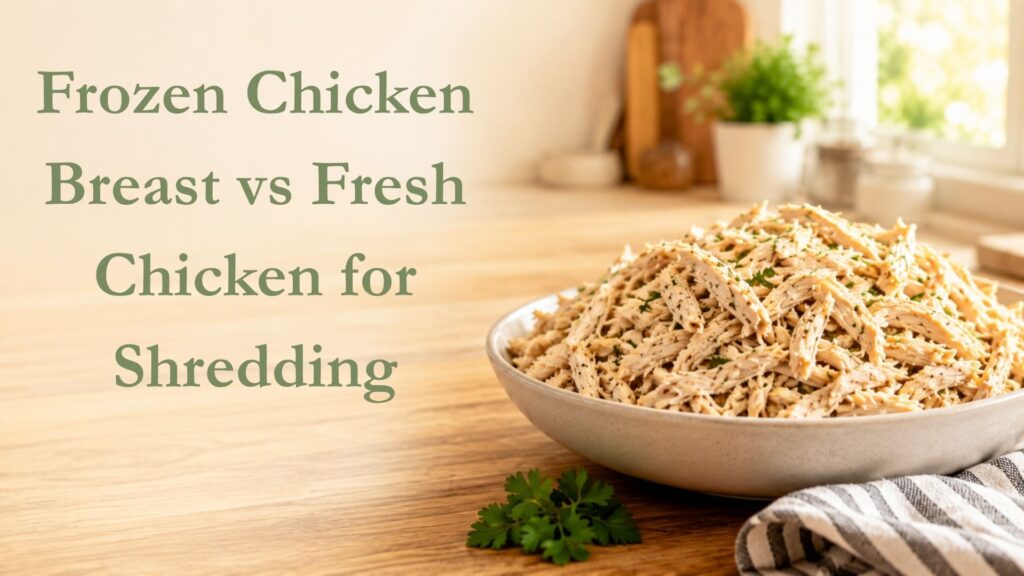
The final shredding difference is usually smaller than the cooking difference. Once either breast is fully cooked, its muscle fibers can separate into similar strands. Moisture control, thickness, cooking method, and how long the meat remains hot have a larger effect on the finished texture than freezing alone.
Those trade-offs are part of cooking frozen chicken for shredding, where the main goal is bringing the cold center fully to temperature without unnecessarily drying the outside.
Frozen vs Fresh Chicken Breast at a Glance
| Factor | Frozen chicken breast | Fresh or thawed chicken breast |
|---|---|---|
| Cooking time | Longer | Shorter |
| Heat distribution | Less even initially | More even |
| Visible cooking liquid | Often more | Usually less |
| Timing predictability | Lower | Higher |
| Shredding potential | Good when cooked correctly | Good when cooked correctly |
| Main risk | Dry exterior before center finishes | Overcooking after center is done |
Why Frozen Chicken Takes Longer
A frozen chicken breast begins with ice distributed throughout its muscle tissue. Before normal cooking can progress through the center, heat must warm the frozen tissue and melt that ice.
Fresh or thawed chicken starts much closer to cooking temperature. Heat can move through the meat without first overcoming the frozen center, so the difference between the outside and inside is smaller.
Does Freezing Change the Muscle Fibers?
Freezing changes the water inside chicken tissue into ice. Ice-crystal formation can alter some cell structure, particularly across longer storage periods or repeated freeze-thaw cycles, but the basic muscle-fiber arrangement remains.
Once cooked, both fresh and previously frozen chicken still separate along natural muscle-fiber bundles. The practical difference is often how much liquid is released and how evenly the meat cooked, rather than whether it can shred at all.
Which Produces More Defined Shreds?
Fresh or thawed chicken breast often gives slightly more predictable, defined strands because the piece cooks more evenly from surface to center. This makes it easier to stop cooking before the outside becomes dry.
Frozen breast can produce equally usable shreds, but the longer heat exposure may make the exterior firmer while the center finishes warming. Gentle cooking and prompt temperature checks reduce that difference.
Fresh and Frozen Chicken Need Different Timing
| Method | Fresh or thawed breast | Frozen breast | Main adjustment |
|---|---|---|---|
| Gentle simmer | About 12 to 15 minutes | About 20 to 30 minutes | Start temperature checks later |
| Oven | Shorter | Often about 50 percent longer | Watch exterior moisture |
| Pressure cooker | Shorter pressure cycle | Longer pressure cycle | Account for frozen center |
These are general planning ranges, not fixed finish times. The useful comparison is that frozen chicken needs additional time, while both versions still need to reach at least 165°F (74°C) in the thickest section.
Why Frozen Chicken May Seem Wetter
Frozen chicken often produces more visible liquid in the cooking vessel. Surface ice melts, while heat causes muscle proteins to contract and release additional moisture.
This can create the impression that frozen chicken is inherently juicier, but free liquid around the meat is not the same as moisture retained inside the fibers. The mechanisms behind watery frozen chicken after cooking are mainly about melting ice, released muscle water, and the way the cooking method handles evaporation.
Which Is Easier to Cook for Meal Prep?
Fresh or thawed chicken gives more predictable scheduling because pieces begin at a more uniform temperature. This can matter when you are cooking several batches and need consistent texture.
Frozen chicken has the convenience advantage. It can go directly into suitable cooking methods when thawing was forgotten, reducing planning requirements even though total cooking time is longer.
How to Cook Either One for Shredding
- Choose pieces of reasonably similar thickness when possible.
- Use a cooking method appropriate to the starting condition.
- Allow extra time if the chicken is frozen.
- Begin checking the thickest section before the estimated finish time.
- Confirm at least 165°F (74°C).
- Rest for about 5 minutes.
- Shred while the chicken is still warm.
What Fully Cooked Frozen Chicken Should Feel Like
Properly cooked frozen chicken should feel firm but not rubbery. The fibers should separate along the grain with fork pressure rather than stretching or resisting.
The practical checks used for confirming frozen chicken is fully cooked matter more than whether the chicken started frozen or fresh.
Best Shredding Tools for Either Version
| Tool | Typical time | Texture | Best fit | Trade-off |
|---|---|---|---|---|
| Two forks | 2 to 5 minutes | Medium, controlled | General cooking | More hand effort |
| Hands | 1 to 4 minutes | Coarse to medium | Tacos, wraps | Requires cooling |
| Hand mixer | 30 to 60 seconds | Fine | Casseroles | Can over-shred |
| Stand mixer | 20 to 60 seconds | Fine to medium | Bulk prep | Extra cleanup |
| Shredder bowl | 30 to 90 seconds | Short, uniform | Meal prep | Wet chicken should drain first |
Which Is Better for Different Dishes?
- Chicken salad: fresh or thawed breast gives especially predictable firm strands.
- Tacos: either works once excess surface liquid is drained.
- Soup: differences are less noticeable once the chicken returns to broth.
- Casseroles: either works well with fine to medium shredding.
- Meal prep: thawed chicken gives more predictable timing, while frozen chicken offers more convenience.
Common Comparison Mistakes
- Using identical cooking times: frozen chicken usually needs substantially longer.
- Assuming more visible liquid means more internal juiciness: pooled liquid and retained moisture are different.
- Judging frozen chicken by surface appearance: the center can lag well behind.
- Overcooking fresh chicken for consistency: fresh pieces may finish much sooner than frozen ones.
- Shredding either version while heavily steaming: a short rest improves handling and texture control.
Best Working Choice
Use fresh or fully thawed chicken breast when predictable timing and even cooking matter most. Use frozen chicken when convenience matters more and you have a suitable cooking method. Both can produce good shredded chicken if the thickest part reaches at least 165°F (74°C), the meat is not left cooking unnecessarily, and excess surface liquid is managed before shredding.