
"As an Amazon Associate, I earn from qualifying purchases. This helps support this site at no extra cost to you."
For sliders, plan 3 to 4 ounces of shredded chicken per person in most party settings. That usually covers 2 to 3 sliders per person, with about 1 to 1.5 ounces of shredded chicken per slider depending on bun size and toppings.
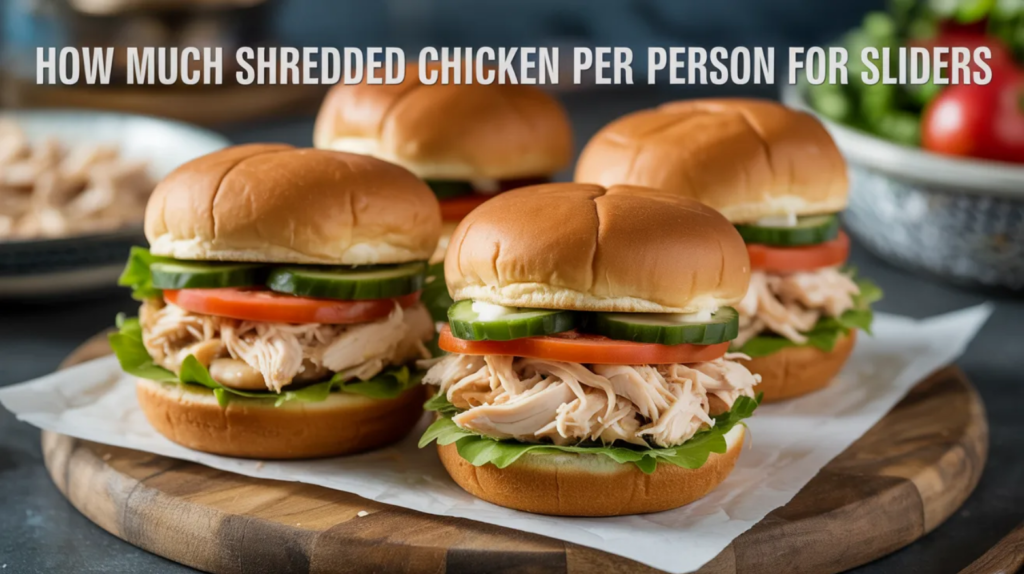
The tricky part with sliders is that people do not think in ounces. They think in pieces. One person may eat two sliders with sides. Another may eat four because sliders go down easily and feel small, even when the filling is fairly generous. That makes slider planning less about a single “serving” and more about how many rounds guests are likely to take.
If you want the full cluster-level baseline before narrowing to slider math, see shredded chicken serving size.
Start with slider count, not cup count
Sliders are one of the few shredded chicken formats where piece count matters more than cup measure.
A standard slider usually works with:
- 1 ounce shredded chicken for a lighter build
- 1.25 ounces for a balanced build
- 1.5 ounces for a fuller build on a soft bun
That means the per-person total depends on how many sliders each guest is expected to eat:
- 2 sliders per person = about 2 to 3 ounces
- 3 sliders per person = about 3 to 4.5 ounces
- 4 sliders per person = about 4 to 6 ounces
For most gatherings, 3 to 4 ounces per person is the safest center point because it lands in the range where guests can have multiple sliders without the tray running short too quickly.
Why slider portions behave differently
Sliders are small, but they are not just miniature sandwiches. They portion differently for three reasons.
First, people usually eat them in multiples. Second, the buns are softer and smaller, so a little shredded chicken spreads farther visually. Third, sliders often show up at parties beside chips, dips, salads, wings, or other finger foods. That naturally pulls the per-person chicken amount downward.
So while sliders are bread-based like sandwiches, they usually need less chicken per person than full sandwiches because the eater is dividing intake across several smaller pieces and often several other foods too. For full-size bun planning, compare shredded chicken per person for sandwiches.
The most useful planning rule
Use this sequence:
Casual party with several sides
Plan 2 to 3 sliders per person and 3 ounces of shredded chicken per person.
Slider-focused meal
Plan 3 sliders per person and 3.5 to 4 ounces per person.
Hungry crowd or light sides
Plan 3 to 4 sliders per person and 4 to 5 ounces per person.
That is usually more practical than trying to guess from one universal slider serving number.
What makes one slider feel properly filled
A good shredded chicken slider should have enough filling to reach the edges of the bun without turning into a top-heavy spill.
The filling is usually right when:
- the top bun sits level instead of floating
- the chicken covers most of the bun surface
- the slider can be picked up without immediate fallout
- the filling still leaves room for sauce, slaw, pickles, or cheese if used
With sliders, the visual target is broad and even, not tall. A high mound looks generous on the tray, but small buns do not support it well.
Quick reference by slider style
| Slider style | Chicken per slider | Chicken per person | Best use |
|---|---|---|---|
| Light party slider | 1 oz | 2 to 3 oz | Buffets with lots of food |
| Standard slider | 1.25 oz | 3 to 4 oz | Most gatherings |
| Hearty slider | 1.5 oz | 4 to 5 oz | Larger appetites or sparse sides |
Where slider math goes wrong
Mistake 1: Using full-sandwich logic
A slider is not a small sandwich with the same appetite pattern. Guests often eat several, but they also pace themselves differently when the food is bite-sized.
Mistake 2: Filling by height
Small buns exaggerate height. A slider can look generously filled while being awkward to eat.
Mistake 3: Ignoring toppings
Slaw, pickles, cheese, and sauce can easily turn a 1-ounce chicken slider into a satisfying piece. Without those additions, the slider may need a little more meat to avoid tasting mostly like bun.
Mistake 4: Underestimating repeat trips
Because sliders feel light, guests often circle back. Initial service may look conservative, but total use climbs over the course of the event.
A fast way to portion sliders for a crowd
This works well for parties, game days, and family trays.
1. Build one test slider
Use the actual buns you are serving, not a guess based on package size.
2. Fill it evenly
Spread the shredded chicken edge to edge. Do not pile it in the center.
3. Close the bun gently
If the filling spills or domes hard under the top bun, reduce it slightly. If the bun closes flat and looks thin, add more.
4. Weigh or estimate that amount once
Now multiply it by the number of sliders you plan to serve.
This quick calibration is more useful than relying on a generic cup estimate, especially when chicken moisture or shred size varies.
How texture changes the portion
Slider portions are especially sensitive to how the chicken is shredded.
Fine, cohesive shreds
These sit neatly on small buns and are easier to portion consistently. They are ideal for assembly-line slider prep.
Coarse, long shreds
These create more loft but can drag out from the sides and make the slider feel messy.
Very wet chicken
This can soak the bun quickly, especially with soft dinner rolls.
Dry chicken
Dry chicken often looks bulky in the pan but compresses into a less satisfying bite once the bun closes.
For sliders, the best texture is usually moist, lightly sauced, and compact enough to stay put.
Cups are less helpful here
You can convert to cups, but sliders are one of the weakest places to rely on cup-only planning. That is because the real question is not “how much chicken does one person get in a bowl?” It is “how much chicken belongs in each bun, and how many buns will each person eat?”
Still, as a rough guide:
- about 1 cup shredded chicken often fills 2 to 3 standard sliders
- finer shreds may stretch a little less visually
- coarser shreds may seem to stretch farther, but distribute less evenly
That is why slider planning works best from per-slider ounces first, then total batch amount second.
Best use-cases for this portion range
This guide fits best when you are making:
- party sliders
- game-day shredded chicken sliders
- Hawaiian roll chicken sliders
- buffet trays
- lunch sliders for a group
- meal-prepped mini sandwiches
It is less useful for full-size buns or open-faced sandwiches, which need a different filling target.
The working answer
For most slider setups, plan 3 to 4 ounces of shredded chicken per person, which usually gives 2 to 3 sliders per person at about 1 to 1.5 ounces each.
Use the lower end when there are lots of sides and appetizers. Use the higher end when sliders are the main event, the buns are slightly larger, or the crowd tends to eat several rounds.
FAQ
How much shredded chicken should I put on one slider?
Use about 1 to 1.5 ounces per slider for most standard buns.
How many sliders does 1 pound of shredded chicken make?
At roughly 1.25 ounces per slider, 1 pound of shredded chicken makes about 12 to 13 sliders.
How many sliders should I plan per person?
Most people eat 2 to 3 sliders in a mixed party setting. Plan more if sliders are the main meal.
Do sliders need as much chicken as sandwiches?
No. Sliders usually need less chicken per person than full sandwiches because the buns are smaller and guests tend to eat them alongside other foods.
Is 2 ounces of shredded chicken enough for one person?
It can be enough for a lighter party portion, but it is usually on the low side unless there are plenty of other foods available.