
"As an Amazon Associate, I earn from qualifying purchases. This helps support this site at no extra cost to you."
Sandwiches go wrong in one of two ways: either the bun dominates and the filling feels thin, or the chicken is piled so high that the sandwich turns messy and unstable. The right target sits between those two problems.
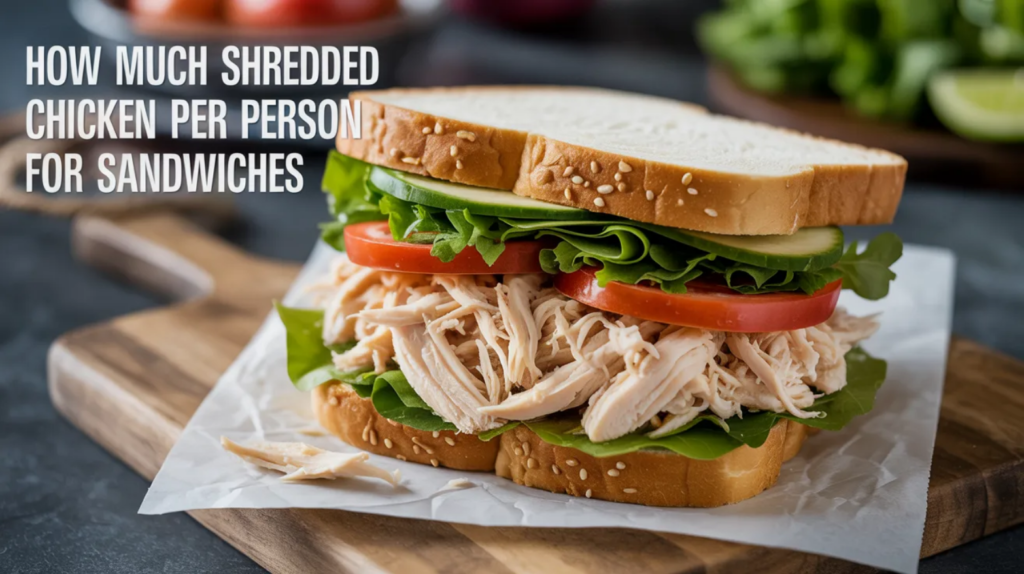
For most sandwiches, plan 4 to 5 ounces of shredded chicken per person. That is usually about 1 to 1 1/4 cups loosely packed, depending on how finely the chicken is shredded and how much sauce is mixed in. This is higher than taco-style serving because bread needs more filling mass to feel balanced across the bite.
If you want the broader baseline before narrowing into sandwiches, see shredded chicken serving size.
Why sandwiches need more chicken than tacos
A taco only needs enough filling to anchor a few compact bites. A sandwich has to carry two larger surfaces of bread and usually one thicker central layer. That shifts the portion logic.
With sandwiches, the chicken needs to provide:
- enough depth so the sandwich does not eat mostly like bread
- enough moisture so the filling does not feel dry through the center
- enough coverage so the edges are not mostly bun
Shredded chicken spreads well, but it also compresses under the top bun. If you under-portion it, the sandwich looks fine at first and then eats flat. That is why sandwiches generally need more than shredded chicken per person for tacos, where the filling is split into smaller, supported builds.
The practical range
Here is the working range for most shredded chicken sandwiches:
| Sandwich style | Shredded chicken per person | What it feels like |
|---|---|---|
| Light sandwich | 3.5 to 4 oz | Acceptable with lots of toppings or sides |
| Standard sandwich | 4 to 5 oz | Balanced for most buns and rolls |
| Hearty sandwich | 5 to 6 oz | Better for larger buns or hungrier eaters |
| Slider-style sandwiches | 3 to 4 oz total | Enough for multiple small sandwiches |
That middle range is the one to use most often. It gives the sandwich enough body without forcing the filling out the sides.
Start with the bread, not the chicken
For sandwiches, the bun or roll tells you more than the bowl of chicken does.
Small soft buns
Use about 4 ounces per person. Small buns fill quickly, especially if the chicken is sauced and topped with slaw or pickles.
Standard sandwich buns or rolls
Use 4 to 5 ounces per person. This is the most reliable all-purpose target.
Large kaiser rolls, hoagie rolls, or oversized buns
Use 5 to 6 ounces per person if the sandwich is supposed to feel full. Bigger bread absorbs more filling before it looks or eats substantial.
This “bread-first” approach is more useful than cup math alone because the structure of the sandwich controls how much chicken the eater expects.
What 4 to 5 ounces looks like in a sandwich
A proper shredded chicken sandwich usually has a filling layer that is thick enough to hold shape when pressed lightly, but not so tall that it slips apart when bitten.
In volume terms:
- 1 cup loosely packed is often close to the low end of a full sandwich serving
- 1 1/4 cups loosely packed is closer to a hearty build
- under 1 cup can work, but usually only if toppings are doing some of the bulk work
The chicken should spread edge to edge across most of the bun. Gaps matter more in sandwiches than in tacos because every bite crosses the bread.
When to use less
Not every sandwich needs the upper end.
Use closer to 4 ounces per person when:
- the sandwich includes bulky slaw
- the chicken is heavily sauced
- the buns are on the smaller side
- there are substantial sides like chips, salad, or soup
- the meal is part of a larger spread
Sauce and slaw both increase perceived fullness. They do not replace the chicken entirely, but they reduce how much meat is needed for the sandwich to feel complete.
When to use more
Push toward 5 to 6 ounces per person when:
- the buns are large
- the toppings are light
- the chicken is the clear focus
- the meal is for bigger appetites
- the sandwich is meant to function as a hearty main with minimal sides
Dryer chicken also sometimes needs slightly more volume because it compresses into a thinner-feeling layer.
A better way to portion sandwich filling
Instead of scooping directly onto each bun and hoping it looks right, use this sequence:
1. Build one test sandwich
Take one bun from the actual package you are serving.
2. Add chicken until the layer looks even and covers the bun
Do not mound it in the center. Spread it out.
3. Press the top bun on lightly
If the sandwich flattens into a thin layer, add more. If the filling spills immediately, reduce it.
4. Weigh or measure that test portion once
Now you have the right serving size for the whole batch.
This takes about 1 to 2 minutes and works better than guessing from a stock serving chart.
Texture matters more in sandwiches
The same amount of chicken can behave differently depending on shred style.
Fine shreds
These pack tighter, hold sauce well, and create a more cohesive sandwich filling. They can feel dense and tidy, which is good for soft buns.
Coarse shreds
These create more loft and visual fullness but can slide out more easily, especially if the sandwich has slick sauce or crunchy toppings.
Very wet shredded chicken
This can make the bun soggy and the filling collapse under pressure.
Very dry shredded chicken
This often needs extra sauce or a slightly larger portion so the sandwich does not eat chalky through the center.
For sandwiches, the best texture is usually moist and cohesive, but not drippy.
Common mistakes with shredded chicken sandwiches
Using a taco-sized portion
A taco amount often disappears inside sandwich bread. What feels generous in a tortilla can feel thin in a bun.
Piling high instead of spreading evenly
Height looks impressive but does not improve the bite if the edges of the sandwich are bare.
Ignoring sauce weight
A heavily sauced cup of chicken is not the same as a cup of plain chicken. The sandwich may look full while carrying less actual meat.
Choosing volume without checking compression
Shredded chicken settles once the bun is closed. What looks like enough in the tray can become a thin layer after assembly.
Where this portion guide works best
This article is most useful for:
- pulled-style shredded chicken sandwiches
- barbecue chicken sandwiches
- shredded chicken on brioche buns or sandwich rolls
- casual lunch service
- party sandwich trays
- meal-prep sandwich filling
For smaller party buns, the math changes because guests usually eat several pieces rather than one full sandwich. That is why shredded chicken per person for sliders needs its own numbers.
The answer to use
For most shredded chicken sandwiches, plan 4 to 5 ounces per person, or about 1 to 1 1/4 cups loosely packed. Use less for smaller buns or topping-heavy builds. Use more for large rolls, sparse toppings, or hearty main-course sandwiches.
That range usually gives you a sandwich that feels filled, balanced, and stable enough to eat without wasting chicken or serving mostly bread.
FAQ
How much shredded chicken should I put on one sandwich?
A good target is 4 to 5 ounces for a standard sandwich.
Is 1 cup of shredded chicken enough for a sandwich?
Usually yes, especially for a standard bun with sauce or toppings. Larger buns may need a little more.
Do sandwiches need more shredded chicken than tacos?
Yes. Sandwiches usually need more filling mass because the bread requires a thicker central layer.
How much shredded chicken per person for BBQ sandwiches?
Plan 4 to 5 ounces per person for most BBQ-style shredded chicken sandwiches, adjusting upward for larger buns.
How much shredded chicken do I need for small buns?
For smaller buns, about 4 ounces per person is often enough, especially with slaw or sauce.