
"As an Amazon Associate, I earn from qualifying purchases. This helps support this site at no extra cost to you."
For most meals, plan 4 to 6 ounces of cooked pulled chicken per person. Use the lower end when people are building tacos, bowls, or plates with several sides. Use the higher end when pulled chicken is the main focus, especially for sandwiches or hungrier groups. That range matches the broader serving logic already used on your live large-group shredded-chicken guide.
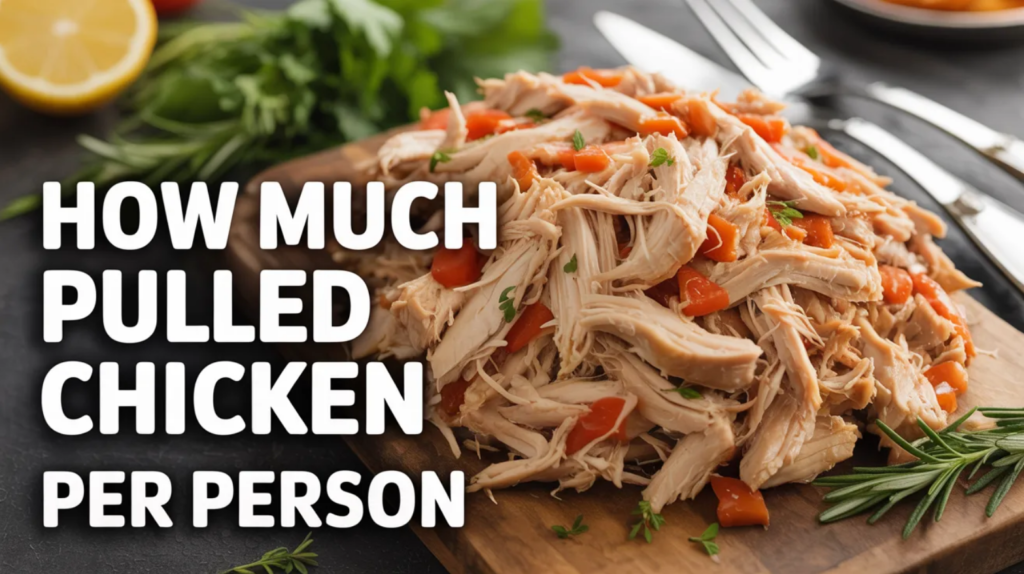
If you want the crowd-planning version with larger group examples and calculator-style thinking, start with how much shredded chicken per person.
Start with the number that usually works
Here is the fastest way to plan pulled chicken without overthinking it:
| Serving situation | Cooked pulled chicken per person | What that looks like in practice |
|---|---|---|
| Tacos, nachos, rice bowls, buffet with lots of sides | 3 to 4 oz | Light-to-moderate filling portion |
| Standard family meal, wraps, mixed plates | 4 to 5 oz | Safe middle ground for most groups |
| Sandwiches, sliders, fewer sides, hungrier eaters | 5 to 6 oz | Heavier main-protein portion |
| Very hearty eaters or planned leftovers | 6 to 7 oz | Built-in cushion |
The reason this works is simple: pulled chicken is rarely served like a full plated chicken breast. It is usually a filling or mixed protein, so tortillas, buns, rice, beans, slaw, chips, and toppings absorb part of the appetite. That same crowd-planning logic shows up across your existing large-group content.
Quick picks by meal type
Taco night
Plan 4 ounces cooked per person.
That usually covers 2 to 3 tacos with toppings. Drop closer to 3 ounces if you also have rice, beans, chips, queso, and multiple toppings. Push toward 5 ounces if the taco filling is doing most of the work.
Pulled chicken sandwiches
Plan 5 to 6 ounces cooked per person.
Buns encourage bigger servings than tacos because the chicken is the main center of the meal. People also tend to come back for seconds more often.
Salads and lettuce wraps
Plan 3 to 4 ounces cooked per person.
These meals are lighter by design, and the pulled chicken is usually one component among vegetables, dressing, grains, or toppings.
Meal prep bowls
Plan 4 to 5 ounces cooked per portion.
That gives enough protein to make the bowl feel complete without overloading the container.
Party buffet with several mains
Plan 3 to 4 ounces cooked per person.
If guests also have another protein choice, pulled chicken demand usually drops. Your live large-group event page makes the same point: more options and more sides usually mean less chicken per person.
Why pulled chicken portions can look smaller than expected
Pulled chicken spreads differently than sliced or whole chicken.
Once the meat is pulled, the fibers separate and trap air between strands. That creates more visual volume in the serving tray, even when the actual weight is modest. A 4-ounce portion of pulled chicken can look generous in tacos or bowls because the meat covers more area than a compact chunk of chicken.
That is why planning by weight is more reliable than planning by scoops or cups.
A second texture factor matters too: pulled chicken is easier to distribute across a plate. People naturally build around it, especially when sauces and toppings are involved. In practical terms, that lowers per-person weight needs compared with a whole-cut chicken entrée.
A better way to estimate than “one chicken breast per person”
That rule usually overshoots.
A whole cooked chicken breast is often much more than a typical pulled-chicken portion once it is served inside tacos, bowls, sandwiches, or mixed plates. Pulled chicken is a component, not usually a standalone slab of protein.
Use this instead:
- Light meal with sides: 3 to 4 oz cooked
- Normal main-protein use: 4 to 5 oz cooked
- Heavier sandwich-style serving: 5 to 6 oz cooked
That gives you a planning system instead of a guess.
Portion planner by group size
| Number of people | Light serving 3-4 oz each | Standard serving 4-5 oz each | Heavy serving 5-6 oz each |
|---|---|---|---|
| 4 | 12-16 oz (0.75-1 lb) | 16-20 oz (1-1.25 lb) | 20-24 oz (1.25-1.5 lb) |
| 6 | 18-24 oz (1.1-1.5 lb) | 24-30 oz (1.5-1.9 lb) | 30-36 oz (1.9-2.25 lb) |
| 8 | 24-32 oz (1.5-2 lb) | 32-40 oz (2-2.5 lb) | 40-48 oz (2.5-3 lb) |
| 10 | 30-40 oz (1.9-2.5 lb) | 40-50 oz (2.5-3.1 lb) | 50-60 oz (3.1-3.75 lb) |
| 20 | 60-80 oz (3.75-5 lb) | 80-100 oz (5-6.25 lb) | 100-120 oz (6.25-7.5 lb) |
These numbers stay consistent with the broader ranges on your existing “how much shredded chicken per person” guide, especially the 20-person planning examples.
Cooked weight first, raw weight second
This is the point that causes most underbuying.
People eat cooked pulled chicken, but you usually shop for raw chicken. Chicken loses moisture during cooking, so raw weight needs to be higher than the finished pulled weight. Your current large-group guide uses a practical assumption of roughly 25 to 30% cooking loss for boneless chicken, which is a solid kitchen planning range.
A simple working conversion:
- 1 pound raw boneless chicken = about 12 ounces cooked
- Or put another way:
- 4 pounds cooked = about 5.25 to 5.5 pounds raw
- 5 pounds cooked = about 6.5 to 6.75 pounds raw
- 6 pounds cooked = about 8 pounds raw
Use the higher raw estimate when:
- you cook hotter or longer
- you start with lean breast meat
- you want a cushion for seconds or leftovers
What changes the number the most
Sides
More sides usually means less chicken per person. Rice, beans, buns, potatoes, pasta salad, chips, and toppings all reduce protein demand.
Form of serving
People take less pulled chicken in tacos than on sandwiches. Bread tends to pull portion size upward.
Sauce level
Sauced pulled chicken feels more substantial in sandwiches and buffet trays, but that does not mean you should count sauce as meat. Plan meat weight first.
Appetite level
Teenagers, game-day groups, and minimal-side meals usually need the top end of the range.
Leftovers on purpose
If you want extra for lunch bowls or sandwiches the next day, add 10 to 20%.
The easiest portion rule for home cooks
For a normal family-style meal, remember this:
Plan about 1 pound of cooked pulled chicken for every 4 people.
That gives you roughly 4 ounces each, which fits most tacos, bowls, wraps, and mixed dinners. Move up to 1.25 to 1.5 pounds per 4 people for sandwich-heavy meals or hungrier groups.
It is not mathematically perfect, but it is kitchen-practical.
Common planning mistakes
Counting cups instead of ounces
Pulled chicken packs loosely or tightly depending on shred size, moisture, and sauce. Weight is more predictable.
Forgetting that sandwiches eat bigger
Tacos and bowls can get away with smaller portions. Sandwiches usually cannot.
Buying raw chicken equal to the cooked amount needed
This is the classic shortfall. Cooking loss matters.
Ignoring texture loss from overholding
Pulled chicken that sits hot too long dries and tightens, which can make a normal planned portion feel skimpy. Moist, tender chicken “eats bigger” than dry strands.
Best-use shortcuts
For fast planning, use these:
- Tacos: 4 oz per person
- Bowls: 4 to 5 oz per person
- Salads: 3 to 4 oz per person
- Sandwiches: 5 to 6 oz per person
- Buffet with lots of sides: 3 to 4 oz per person
- Want leftovers: add 10 to 20%
Quick answer
A good default is 4 to 6 ounces of cooked pulled chicken per person. Use 3 to 4 ounces for tacos, bowls, salads, or buffets with plenty of sides. Use 5 to 6 ounces for sandwiches or heavier meals. For larger-group planning and cooked-to-raw conversion logic, see how much shredded chicken per person.
Final planning note
Pulled chicken portions are easier to get right when you think about how the meat is being used, not just how many people are coming. Fiber separation gives pulled chicken more tray coverage and easier distribution, so the correct serving size depends heavily on whether it is a filling, a topping, or the clear center of the plate.
That is why a taco bar, a meal-prep bowl, and a sandwich tray should not all use the same number.